By the end of this topic
- Describe the jobs of the main cell structures.
- Compare typical plant and animal cells.
- Put cells, tissues, organs and organ systems in order.
- Calculate image size using magnification.
01Key terms & definitions
- Cell
- The smallest unit that carries out the processes of life.
- Nucleus
- The cell structure that contains genetic information and helps control the cell.
- Cell membrane
- The thin boundary that controls what enters and leaves a cell.
- Cytoplasm
- The jelly-like material in a cell where many chemical reactions happen.
- Tissue
- A group of cells working together to do a particular job.
- Organ
- A structure made of different tissues working together.
02Understand the idea
What is a living thing?
A living thing is called an organism. A daisy, a human and a bacterium are all organisms. Living things are made of cells. Bacteria have one cell; humans have many.
Living things carry out linked life processes:
- Nutrition: obtaining the nutrients needed for life.
- Respiration: releasing energy from nutrients.
- Growth: increasing in size or developing.
- Response: reacting to changes in the surroundings.
- Excretion: removing waste made by the body’s chemical reactions.
- Reproduction: producing new organisms. An individual that cannot reproduce is still alive.
Cells: the building blocks of life
A cell is the smallest unit that carries out the processes of life. Most cells are too small to see clearly without a microscope. Inside a cell, different structures carry out different jobs.
| Structure | Job |
|---|---|
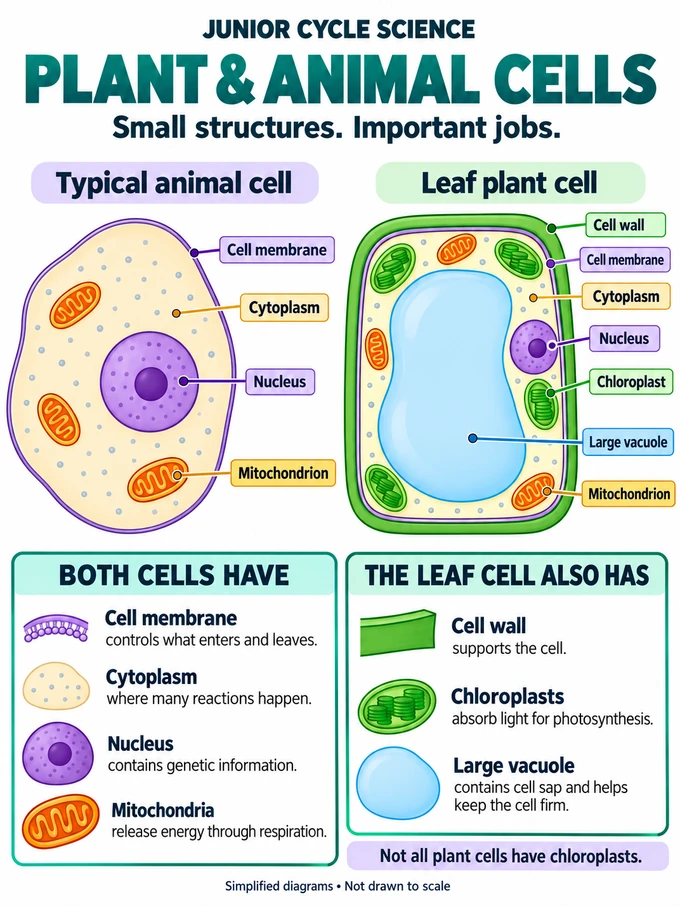
| Cell membrane | Controls which substances enter and leave the cell. |
| Cytoplasm | Jelly-like material where many chemical reactions take place. |
| Nucleus | Contains genetic information and helps control the cell’s activities. |
| Mitochondria | Carry out most stages of aerobic respiration, which uses oxygen to release energy for the cell. |
Plant cells and animal cells
Typical plant and animal cells both have a membrane, cytoplasm, a nucleus and mitochondria. Plant cells have some extra structures.
| Plant-cell structure | Job |
|---|---|
| Cell wall | A strong outer layer made of cellulose. It supports the cell. |
| Large vacuole | Contains cell sap and helps keep the cell firm. |
| Chloroplasts | Contain chlorophyll, which absorbs light so the plant can make food by photosynthesis. |
Cells are suited to their jobs
Cells have structures suited to their jobs. A leaf cell and a root cell need not look the same.
- Photosynthesising leaf cells contain chloroplasts to absorb light.
- Most root cells have no chloroplasts because they receive little or no light.
- A cell diagram is a simplified model. A real cell may have a different shape, and some structures may be too small or faint to see.
From cells to organ systems
In a many-celled organism, cells work together. The order is: cell → tissue → organ → organ system → organism.
- Cells form tissues: heart muscle cells form muscle tissue.
- Different tissues form organs: the heart contains muscle tissue and other tissues.
- Organs form organ systems: the heart and blood vessels make up the circulatory system.
Using a microscope
A microscope makes small objects appear larger. Magnification tells you how many times larger the image is than the actual object.
- ×50 magnification means the image is 50 times the actual size.
- Image size = actual size × magnification.
- Use the same length unit for image size and actual size.
- Draw clear outlines and label the structures you can see.
A question scientists discuss
Viruses contain genetic information but cannot reproduce on their own. They must use living cells. This is why scientists discuss whether viruses should be classed as living things.
03Worked examples
A cell is 0.20 mm wide. At ×50 magnification, its image is 10 mm wide.
Work through it
- Write the rule: image size = actual size × magnification.
- Both sizes will be measured in millimetres.
- Calculate 0.20 × 50 = 10 mm.
04Common mistakes
Common mistake
“Every plant cell has chloroplasts.”
Remember: Most root cells have no chloroplasts because they receive little or no light. They are still plant cells.
Common mistake
“The cell wall and cell membrane do the same job.”
Remember: The wall supports the cell. The membrane controls what enters and leaves. A plant cell has both.
05Answering questions
- When asked about a cell structure, name it and link it to its job: for example, chloroplasts absorb light for photosynthesis.
- For magnification calculations, put image size and actual size in the same units before using the formula.
06Infographic & reference diagrams
07Try an investigation
Use a microscope to observe teacher-prepared plant and animal cells. Begin with low magnification. Draw what you see and label the visible structures. Follow your teacher’s instructions for slides and stains.
Do practical work with your teacher and follow the laboratory safety instructions.