By the end of this topic
- Explain exothermic and endothermic reactions.
- Describe activation energy.
- Read a simple energy profile.
- Explain how a catalyst affects an energy profile.
01Key terms & definitions
- Exothermic reaction
- A reaction that releases energy to its surroundings.
- Endothermic reaction
- A reaction that takes in energy from its surroundings.
- Activation energy
- The minimum energy needed for a successful reaction.
- Energy profile
- A diagram showing the energy of reactants, products and the energy hurdle between them.
- Surroundings
- The solution, container, air and other things around the reacting substances.
- Fuel
- A substance used to release useful energy, usually by burning.
02Understand the idea
Reactions transfer energy
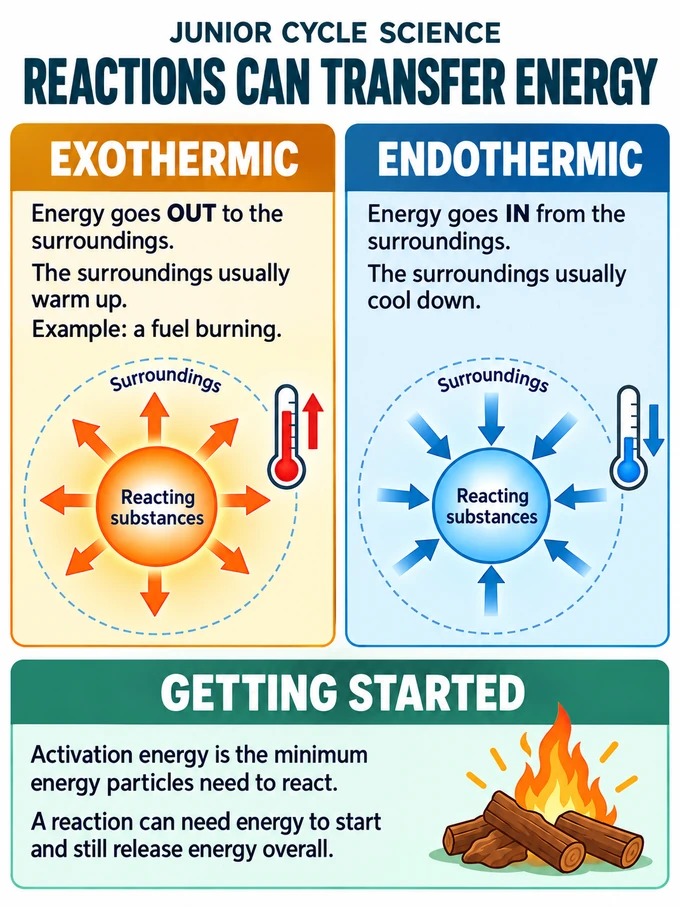
Reactions transfer energy between reacting substances and their surroundings.
- The surroundings include the solution, container and nearby air.
- A temperature rise shows that the surroundings gained energy.
- A temperature fall shows that the surroundings lost energy.
Exothermic reactions
An exothermic reaction releases energy to its surroundings: “exo” means out.
- The surroundings usually become warmer.
- Examples: burning a fuel and many neutralisation reactions.
Endothermic reactions
An endothermic reaction takes in energy from its surroundings: “endo” means in.
- The surroundings usually become cooler.
- In a laboratory reaction, a fall in the solution’s temperature can show energy being taken in.
- Photosynthesis is an energy-taking process powered by light. It does not rely on cooling the surroundings.
Activation energy: getting started
Activation energy is the minimum energy reacting particles need for a successful reaction.
- Even an exothermic reaction may need energy to start: a match must be struck before it burns.
- Think of activation energy as an initial hurdle.
- It is different from the overall energy released or taken in.
Reading an energy profile
An energy profile is a diagram showing energy before, during and after a reaction. The vertical axis shows energy. The horizontal axis shows the progress of the reaction.
- Reactants are shown at the starting level.
- The peak shows the energy hurdle.
- The rise from the reactant level to the peak is the activation energy.
- Products are shown at the final level.
Comparing the starting and final levels
Compare the reactant and product energy levels to find the overall energy change.
- Exothermic: products are lower; the difference is energy released.
- Endothermic: products are higher; the difference is energy taken in.
- Energy is transferred, not created or destroyed.
What does a catalyst change?
A catalyst provides a route with lower activation energy.
- The energy-profile peak is lower, so more particles can react successfully.
- The reaction is faster.
- Reactant and product levels stay the same, so the overall energy change stays the same.
Comparing temperature changes
Use a fair test when comparing reactions using temperature changes.
- Keep the amounts of substances and apparatus the same.
- Insulation reduces energy loss to the air.
- A larger temperature rise does not automatically mean a better fuel: fuel mass, water amount and energy losses affect the result.
- Fuel choices also involve cost, availability and pollution.
03Worked examples
An example energy profile shows reactants at 80 units, a peak at 120 units and products at 30 units. Find the activation energy and the energy released.
Work through it
- Activation energy is the rise from reactants to the peak: 120 − 80 = 40 units.
- Energy released is the drop from reactants to products: 80 − 30 = 50 units.
- The products are lower than the reactants, so the reaction is exothermic. These are example energy units.
04Common mistakes
Common mistake
“Exothermic means energy is taken into the reaction.”
Remember: Exothermic means energy leaves the reaction and enters the surroundings, which usually warm up.
Common mistake
“A catalyst changes the total energy released.”
Remember: A catalyst lowers activation energy but leaves the reactant and product energy levels unchanged.
05Answering questions
- On an energy profile, measure activation energy from the reactant level to the peak, not from zero.
- Use the reactant and product levels to decide whether the reaction is exothermic or endothermic, then state the direction of energy transfer.
06Infographic & reference diagrams
07Try an investigation
Read a teacher-supplied energy profile and label the reactants, products and activation energy. In a supervised temperature-change experiment, record the starting and final temperatures and decide whether the surroundings gained or lost energy.
Do practical work with your teacher and follow the laboratory safety instructions.