By the end of this topic
- Describe physical and chemical properties of materials.
- Link a material’s properties to its use.
- Plan a fair comparison of two materials.
01Key terms & definitions
- Physical property
- A feature that can be measured without making a new substance, such as density.
- Chemical property
- How a substance reacts to form new substances, such as rusting or burning.
- Conductivity
- How easily a material carries electric current or transfers heat.
- Solubility
- The maximum amount that dissolves in a given amount of solvent at a stated temperature.
- Durability
- How well a material lasts during use.
- Composite
- A material made by combining different materials to get useful properties.
02Understand the idea
Choosing a material for a job
A property is a feature of a material. We choose materials whose properties suit the job.
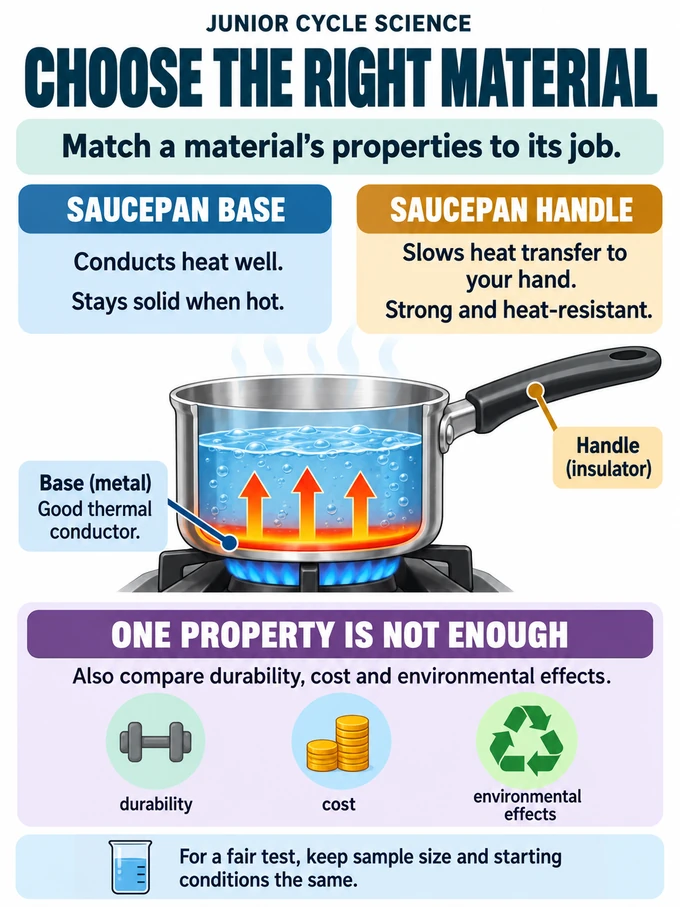
- A saucepan base needs to transfer heat to food.
- A handle must be strong and transfer as little heat as possible to your hand.
- Different parts of one object may need different materials.
Physical properties
A physical property can be observed or measured without changing the substance into something new.
| Property | What it tells us | Example of a use |
|---|---|---|
| Strength | How well a material resists breaking under a force. | Steel in a bridge. |
| Density | How much mass there is in a given volume. | Light materials in aircraft. |
| Melting point | The temperature at which a solid becomes liquid. | Materials that stay solid in a hot oven. |
| Thermal conductivity | How easily heat passes through a material. | Metal in a saucepan base. |
| Electrical conductivity | How easily electric current flows through it. | Copper in electrical wires. |
| Solubility | How much of it dissolves in a given amount of solvent. | Dissolving a soluble substance to separate a mixture. |
Conductors and insulators
Thermal and electrical conductivity describe different properties.
- Thermal conductor: transfers heat easily.
- Thermal insulator: slows heat transfer, so a suitable insulating handle warms more slowly.
- Electrical conductor: allows current to flow easily.
- Electrical insulator: resists current flow.
- Many metals are good conductors of both heat and electricity.
Chemical properties
A chemical property describes how a substance reacts to form new substances.
- Burning and corrosion are chemical changes.
- Iron reacts with oxygen and water to form rust.
- For outdoor objects, choose corrosion-resistant materials or protect iron with a coating.
Making a fair comparison
For a fair comparison, change the material and keep other important factors the same.
- Insulation test: use equal sleeve thicknesses, identical cups, equal water volumes and the same starting temperature.
- Measure after the same time. A smaller temperature drop suggests less energy escaped.
- Repeat the test to check consistency.
- Solubility test: keep solvent volume and temperature the same; measure the amount that dissolves before saturation.
- Equal stirring times alone do not measure the maximum amount that can dissolve.
More than one property matters
One useful property does not guarantee that a material suits the job.
- A pan base must conduct heat and stay solid when hot.
- A handle needs low thermal conductivity, strength and resistance to its working temperature.
- Durability means how well a material lasts in use.
- Also consider cost, repair, reuse and environmental effects.
- A composite combines materials for useful properties. Reinforced concrete combines concrete and steel.
03Worked examples
Material A melts at 70 °C and is a poor heat conductor. Material B melts at 660 °C and is a good heat conductor. Which better suits a pan base that may reach 180 °C?
Work through it
- At 180 °C, material A would have melted because its melting point is only 70 °C.
- Material B would still be solid, and it transfers heat well.
- B better meets these two requirements. We would also check strength, food safety and cost before choosing it.
04Common mistakes
Common mistake
“The best heat conductor is also the best saucepan-handle material.”
Remember: A handle needs low thermal conductivity to slow heat transfer to your hand.
Common mistake
“An insulating material stops all heat transfer.”
Remember: Insulation slows heat transfer; it does not prevent it completely.
05Answering questions
- Link each material property to the job: for example, copper conducts electricity well, so it suits the conducting part of a wire.
- For a fair comparison, state what you change, what you measure and the important factors you keep the same.
06Infographic & reference diagrams
07Try an investigation
Compare insulating sleeves around identical cups of warm water. Keep the sleeve thickness, water volume, starting temperature and measuring time the same. Use safe water temperatures selected by your teacher.
Do practical work with your teacher and follow the laboratory safety instructions.