By the end of this topic
- Explain current, voltage and resistance.
- Connect an ammeter and voltmeter correctly.
- Compare series and parallel circuits.
- Explain how a switched LED circuit and an LDR work.
01Key terms & definitions
- Current
- The amount of electric charge passing a point each second. Measured in amperes (A).
- Potential difference
- The energy transferred for each coulomb of charge between two points. Also called voltage; measured in volts (V).
- Resistance
- How strongly a component opposes current. Calculate it by dividing voltage by current; measured in ohms (Ω).
- Series circuit
- A circuit with one path for the current.
- Parallel circuit
- A circuit with separate branches for the current.
- Sensor circuit
- A circuit that responds to a change such as a change in light level or temperature.
02Understand the idea
A complete circuit
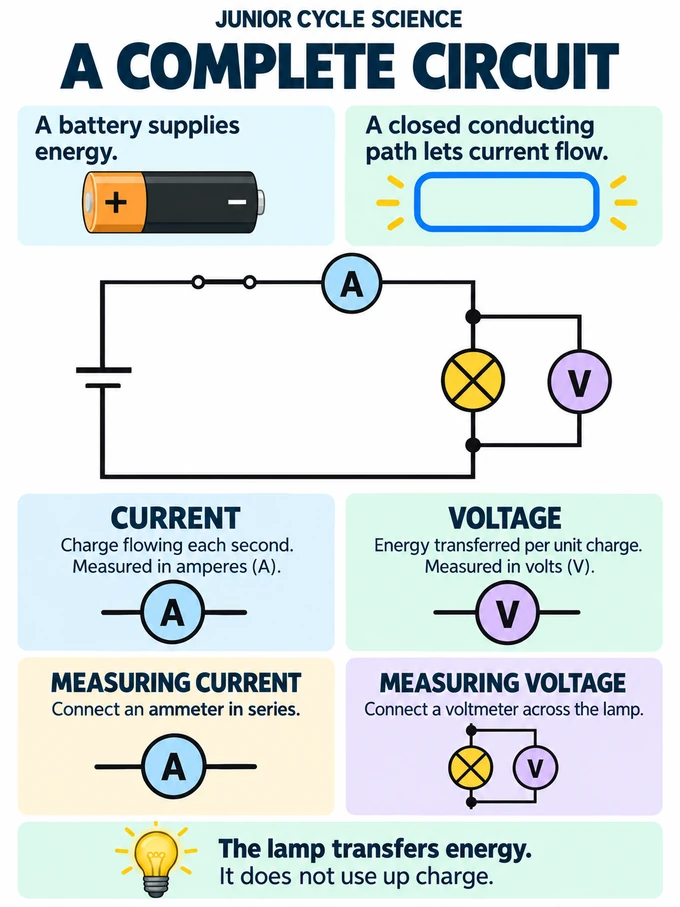
A circuit is a conducting path that lets charge flow. A cell or battery supplies energy.
- Closed switch: a complete path allows current to flow.
- Open switch: a gap stops the current in that path.
- In metal wires, moving electrons carry charge.
- Conventional current goes from positive to negative around the outside circuit. Electrons move in the opposite direction.
Current and potential difference
Current describes charge flow. Potential difference describes energy transferred per charge.
- Current: charge passing a point each second, measured in amperes (A). One A = one coulomb each second.
- Potential difference (voltage): energy transferred per coulomb, measured in volts (V).
- A 6 V battery supplies 6 J of energy per coulomb of charge.
- A lamp transfers energy by light and heating. It does not use up charge.
- In a simple series circuit, current is the same before and after the lamp.
Measuring current and voltage
Use the correct meter connection for each measurement.
- Ammeter: connect in series so the current passes through it.
- Voltmeter: connect in parallel, across the component’s two ends.
- Switch off before changing connections.
- Never connect an ammeter directly across a battery: it can cause a very large current.
Resistance
Resistance describes how strongly a component opposes current. It is measured in ohms (Ω).
- For a fixed voltage, greater resistance gives smaller current.
- Resistance = voltage ÷ current: R = V ÷ I.
- Example: 6 V and 0.20 A give R = 6 ÷ 0.20 = 30 Ω.
- Convert milliamps to amps before calculating: divide by 1000. For example, 2 mA = 0.002 A.
Series and parallel circuits
A series circuit has one current path. A parallel circuit has separate branches.
| Feature | Series circuit | Parallel circuit |
|---|---|---|
| Current | The same current passes through every component. | Current splits at a junction; the branch currents add to the total. |
| Voltage | The voltages across components add up to the supply voltage. | Branches connected across the same supply have the same voltage. |
| One lamp removed | The only path is broken, so the other lamps go out. | Other complete branches can keep working. |
Using an LED
An LED is a light-emitting diode. It lights when current passes through it in the correct direction.
- Its two connections are the anode and cathode.
- Connect the anode towards battery positive and the cathode towards battery negative.
- Use a suitable series resistor to limit current and protect the LED.
Building a switched indicator
This classroom example uses a teacher-checked 3 V battery pack, switch, red LED and 330 Ω resistor.
- Connect in series: battery positive → switch → resistor → LED anode → LED cathode → battery negative.
- Draw the circuit first. Build with power off and have the teacher check the connections and LED rating.
- Closing the switch lights the LED; opening it switches the LED off.
- If the LED has about 2 V across it, the resistor has about 1 V. Current ≈ 1 ÷ 330 A ≈ 0.003 A = 3 mA.
- The exact current depends on the LED. Keep the protective resistor in the circuit.
Sensing light
A light-dependent resistor (LDR) changes resistance with light level.
- Brighter light: usually lower resistance. Darkness: higher resistance.
- LDRs can be used in light-sensitive circuits, such as automatic night-lights.
- An LDR is not an on/off switch by itself. Other components turn its changing signal into a switching action.
03Worked examples
A resistor has a potential difference of 6 V across it. The current through it is 0.20 A. Find its resistance.
Work through it
- Identify the voltage, 6 V, and current, 0.20 A.
- Use resistance = voltage ÷ current.
- R = 6 ÷ 0.20 = 30 Ω.
Another example
- For a red LED with about 2 V across it on a 3 V supply, the resistor has about 3 − 2 = 1 V across it.
- With a 330 Ω series resistor, current = 1 ÷ 330 ≈ 0.003 A = 3 mA.
- Use the teacher-approved LED and resistor. Disconnect the supply before checking an LED that does not light.
04Common mistakes
Common mistake
“Saying a lamp uses up current.”
Remember: It transfers energy but does not use up charge. Current is the same around a simple series loop.
Common mistake
“Connecting an ammeter across a component like a voltmeter.”
Remember: Connect the ammeter in series. The voltmeter goes across the component.
05Answering questions
- Trace a complete path through your circuit diagram and check where each meter is connected.
- Before using R = V ÷ I, convert milliamps to amps and identify the voltage across the same component.
06Infographic & reference diagrams
07Try an investigation
Build a low-voltage circuit with cells, a switch and a lamp. Measure current in series and voltage across the lamp. Then compare series and parallel lamp circuits. Switch off before changing connections and ask your teacher to check them. Use batteries or the approved low-voltage supply, never household mains sockets.
Do practical work with your teacher and follow the laboratory safety instructions.