By the end of this topic
- Explain how a scientific idea is used in a technology.
- Distinguish electrical power from electrical energy.
- Compare electricity sources using benefits, drawbacks and evidence.
01Key terms & definitions
- Technology assessment
- Explaining how a technology works and judging its benefits and drawbacks.
- Generation
- Producing electrical energy from another energy source.
- Grid
- The network that carries electricity from generators to users.
- Demand
- The amount of electrical power users need at a particular time.
- Lifecycle impact
- An effect of making, using, maintaining or disposing of a product.
- Trade-off
- A choice that improves one thing but makes another worse.
02Understand the idea
Technology uses scientific ideas
Technology applies scientific ideas to solve problems.
- An ultrasound scanner sends high-frequency sound into the body and detects echoes from boundaries between tissues.
- It uses these echoes to build an image.
- A heat pump uses electrical energy to move energy from cooler surroundings into a warmer building.
- Explain both the scientific idea and how it helps people.
Generating electricity
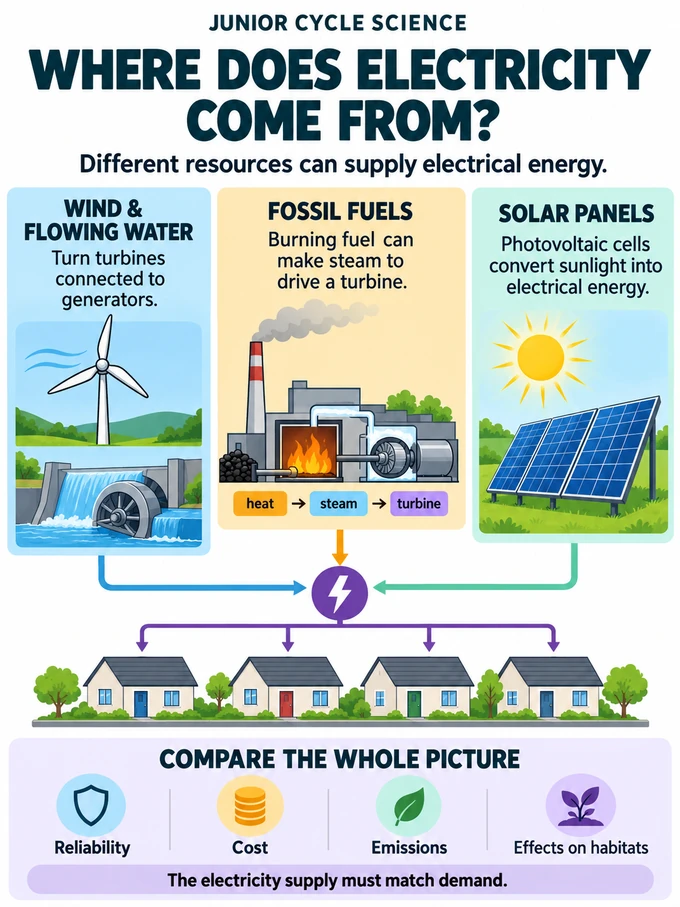
Generation changes other forms of energy into electrical energy.
- In many power stations, a turbine turns a generator.
- Wind turns a wind turbine. Flowing water turns a hydroelectric turbine.
- In a steam power station, burning fuel heats water; the steam drives a turbine.
- Photovoltaic solar panels transfer sunlight directly into electrical energy without a turbine.
Renewable and non-renewable sources
Renewable sources are naturally replaced on a useful human timescale.
- Examples: wind, sunlight and flowing water.
- Coal, oil and natural gas are non-renewable: their supplies take millions of years to form.
- Burning fossil fuels releases carbon dioxide.
- Wind turbines and solar panels burn no fuel while generating, but making and installing them still uses materials and energy.
Getting electricity where and when it is needed
The grid carries electricity from generators to homes, schools and businesses.
- Demand is the electrical power users need at a particular time.
- Supply must match demand.
- Wind and solar output change with weather and time of day.
- An electricity system can combine generators, storage, links to other grids and changes in when electricity is used.
Power ratings and energy output
Power is a rate; energy is an amount.
- One kilowatt (kW) = 1000 W.
- Energy in kWh = power in kW × time in hours.
- A 1.5 kW heater running for 2 hours uses 1.5 × 2 = 3 kWh.
- A turbine’s rated power applies under specified conditions. It does not produce that power all the time.
- Daily energy output depends on how the power changes through the day.
Comparing the full picture
Compare the whole lifecycle: making, using, maintaining and disposing of the equipment.
| Question | Example of what to compare |
|---|---|
| How reliable is the supply? | Can it supply electricity when it is needed? |
| What are the climate effects? | Emissions from making and using the equipment. |
| What are the local effects? | Land use, habitats, noise and effects on neighbours. |
| What does it cost? | Construction, fuel, maintenance and replacement. |
Making a reasoned choice
A trade-off happens when improving one thing makes another worse.
- Example: a project may supply lower-carbon electricity but affect a local habitat.
- Describe benefits and drawbacks using evidence.
- Consider who benefits and who bears the costs. People may accept the same evidence but have different priorities.
- Record the source and date of figures. Electricity supplies and costs change over time.
03Worked examples
Option A supplies an average of 8 kWh of energy per day, but its output changes with the weather. Option B can supply 2 kW of power when needed, provided fuel is available. How can we compare them?
Work through it
- Separate the units: 8 kWh is an amount of energy; 2 kW is a rate of energy transfer.
- If option B runs at 2 kW for 4 hours, it supplies 2 × 4 = 8 kWh.
- Find out when each option can supply energy, then compare fuel use, emissions, costs and local effects. The two original figures alone do not tell us which is better.
04Common mistakes
Common mistake
“Treating a turbine’s rated power as its continuous output.”
Remember: Actual output changes with conditions. Total energy depends on power over time.
Common mistake
“Saying renewable electricity has no environmental effects.”
Remember: Consider making, installing, maintaining and disposing of the equipment as well as its operation.
05Answering questions
- Compare generation options using the same headings and timescale, including reliability, cost and environmental effects.
- Support a recommendation with evidence and acknowledge a drawback. Record the source and date of changing statistics.
06Infographic & reference diagrams
07Try an investigation
Research two ways of generating electricity. Make a table comparing reliability, emissions, costs and effects on people and habitats. Record the date and source of each figure. Use the table to explain a choice and its main drawback.
Do practical work with your teacher and follow the laboratory safety instructions.