By the end of this topic
- Describe the three particles found in atoms.
- Calculate atomic number, mass number and electron number.
- Tell an element, compound and mixture apart.
- Compare metals and non-metals.
01Key terms & definitions
- Atom
- The smallest unit of an element.
- Proton
- A positively charged particle in the nucleus of an atom.
- Neutron
- A particle in the nucleus with no electrical charge.
- Electron
- A negatively charged particle found around the nucleus.
- Element
- A pure substance made of only one type of atom.
- Compound
- A substance made of two or more different elements chemically joined in a fixed ratio.
02Understand the idea
Atoms: the building blocks of matter
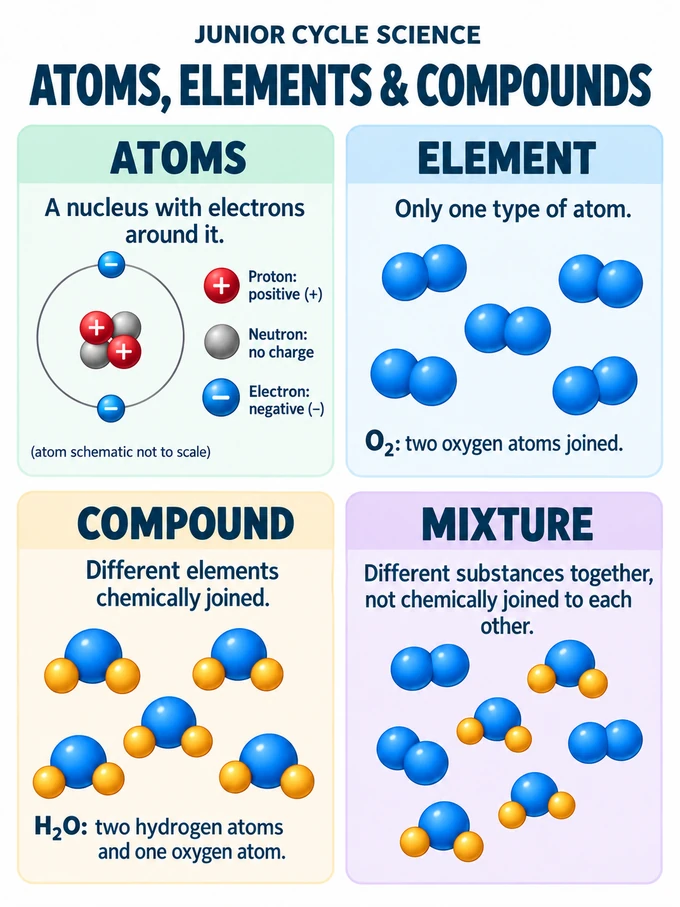
An atom is the smallest unit of an element. All substances are made of atoms.
- The tiny nucleus is at the centre. It contains protons and usually neutrons.
- Electrons are found around the nucleus.
- Almost all the atom’s mass is in the nucleus.
The particles inside an atom
Protons and electrons have opposite charges. The table shows relative charges and masses.
| Particle | Position | Charge | Relative mass |
|---|---|---|---|
| Proton | In the nucleus | +1 | 1 |
| Neutron | In the nucleus | 0 | 1 |
| Electron | Around the nucleus | −1 | About 11836 |
Counting the particles
Atomic number identifies the element: every carbon atom has 6 protons.
- Atomic number = number of protons.
- Mass number = protons + neutrons.
- Neutral atom: electrons = protons, so their charges balance.
- Example: 6 protons and 6 neutrons give atomic number 6 and mass number 12. A neutral atom also has 6 electrons.
Elements
An element is a pure substance made of only one type of atom.
- Each element has a symbol: Cu is copper; O is oxygen.
- Atoms can join to form molecules. An O₂ molecule contains two oxygen atoms.
- O₂ is still an element because only one type of atom is present.
Compounds
A compound contains different elements chemically joined in a fixed ratio.
- Each water molecule, H₂O, has two hydrogen atoms and one oxygen atom.
- A compound has its own properties: hydrogen and oxygen are gases at room temperature, but water is a liquid.
- A chemical reaction is needed to separate a compound into simpler substances.
Mixtures
A mixture contains substances together without being chemically joined to each other.
- Examples: air is a mixture of gases; salt water contains salt and water.
- The amounts can vary: salt water can contain a little salt or a lot.
- Mixtures can be separated by physical methods such as filtration, evaporation or distillation.
| Type | What it contains | Example |
|---|---|---|
| Element | One type of atom. | Copper, Cu. |
| Compound | Different elements chemically joined in a fixed ratio. | Water, H₂O. |
| Mixture | Substances together without being chemically joined to each other. | Salt water. |
Metals and non-metals
Elements can be grouped as metals or non-metals.
- Metals usually conduct heat and electricity well and can be shaped without breaking.
- Many solid non-metals are brittle and poor electrical conductors.
- Exceptions: graphite conducts electricity; mercury is a metal that is liquid at room temperature.
- Copper is both an element and a metal.
- An alloy is a mixture containing a metal and other elements. Brass contains copper and zinc.
03Worked examples
A neutral atom has 6 protons and 6 neutrons. Find its atomic number, mass number and number of electrons.
Work through it
- Atomic number = number of protons = 6. The element is carbon.
- Mass number = protons + neutrons = 6 + 6 = 12.
- The atom is neutral, so electrons = protons = 6.
Another example
- A sample contains copper atoms only, so it is an element.
- Copper is also a metal because of its properties.
- Brass contains copper and zinc, so it is a mixture rather than a pure element.
04Common mistakes
Common mistake
“Any molecule with more than one atom is a compound.”
Remember: A compound needs different elements. O₂ contains only oxygen, so it is an element.
Common mistake
“Mass number is the number of protons only.”
Remember: Mass number = protons + neutrons. Atomic number = protons.
05Answering questions
- In particle diagrams, count the types of atom and check which are joined before classifying the sample.
- For a neutral atom, calculate protons, neutrons and electrons separately. Use neutrons = mass number − atomic number.
06Infographic & reference diagrams
07Try an investigation
Sort particle diagrams into elements, compounds and mixtures. For each diagram, count the different types of atom and check whether they are joined. Compare metal and non-metal samples using a teacher-supervised low-voltage conductivity test.
Do practical work with your teacher and follow the laboratory safety instructions.