By the end of this topic
- Measure length, mass and liquid volume.
- Calculate the area and volume of a rectangular object.
- Find the density of a regular or irregular solid.
01Key terms & definitions
- Length
- Distance between two points, usually measured in metres (m), centimetres (cm) or millimetres (mm).
- Mass
- The amount of matter in an object, measured in kilograms (kg) or grams (g).
- Area
- The size of a surface, measured in square units such as cm².
- Volume
- The space an object or substance takes up. It can be measured in cm³ or mL; 1 mL = 1 cm³.
- Density
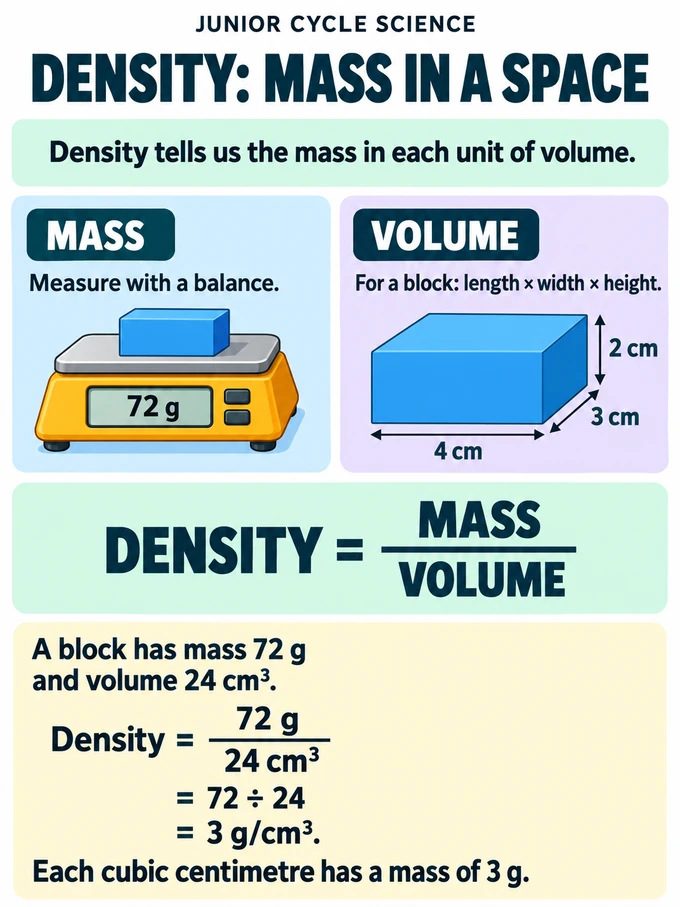
- The mass in each unit of volume. Calculate it by dividing mass by volume.
- Displacement
- The volume of water pushed aside when an object is put completely under water.
02Understand the idea
Measuring length and mass
Length tells us how far apart two points are. Mass tells us how much matter is in an object.
- Measure length with a ruler or measuring tape. Use metres (m), centimetres (cm) or millimetres (mm).
- Place the object at the zero mark. Read the scale directly above its other end.
- If the object starts at another mark, subtract the starting reading from the final reading.
- Measure mass with a balance. Common units are grams (g) and kilograms (kg): 1000 g = 1 kg.
Area is the size of a surface
Area is the size of a surface.
- For a rectangle: area = length × width.
- Use the same unit for both lengths.
- A card measuring 8 cm × 3 cm has an area of 24 cm².
- The unit cm² means square centimetres: the number of 1 cm by 1 cm squares covering the surface.
Volume is the space an object takes up
Volume is the space an object takes up.
- For a rectangular block: volume = length × width × height.
- A block measuring 4 cm × 3 cm × 2 cm has a volume of 24 cm³.
- One cm³ is the volume of a cube with sides of 1 cm. One mL = 1 cm³.
- Measure liquid volume with a measuring cylinder. For water, read the bottom of the curved surface (the meniscus) at eye level.
Finding the volume of an irregular solid
Use water displacement to find the volume of an irregular object, such as a stone.
- Record the initial water reading, then lower the object gently into the water.
- Completely submerge it and remove trapped air bubbles. Record the new reading.
- Object volume = final reading − initial reading.
- A rise from 40 mL to 55 mL gives a volume of 15 mL = 15 cm³.
- The object must not dissolve or change in water. A sugar cube is unsuitable because it dissolves.
What does density tell us?
Density compares the masses of equal volumes of material.
- For equal-sized cubes, the iron cube has more mass than the wooden cube. Iron is denser.
- Density = mass ÷ volume.
- Use mass in g and volume in cm³ to obtain density in g/cm³.
- A density of 3 g/cm³ means each cubic centimetre has a mass of 3 g.
A bigger object is not always denser
A larger piece of the same material has more mass and more volume, but usually the same density.
- If every side of a cube doubles, its surface area becomes four times as large.
- Its volume becomes eight times as large.
- For the same material, its mass also becomes eight times as large. Mass divided by volume stays the same.
Recording a useful measurement
Choose an instrument suited to the measurement.
- A ruler can measure a notebook’s length, but not the size of a single cell.
- Record a unit with each measurement.
- Repeat measurements where possible.
- Only record the precision the instrument allows. Extra calculator digits do not improve a rough measurement.
03Worked examples
density = massvolume
A block has a mass of 72 g. It measures 4 cm long, 3 cm wide and 2 cm high. Find its volume and density.
Work through it
- Multiply the three lengths: volume = 4 × 3 × 2 = 24 cm³.
- Divide mass by volume: density = 72 ÷ 24 = 3 g/cm³.
- This means each cubic centimetre of the material has a mass of 3 g.
04Common mistakes
Common mistake
“Using the final cylinder reading as the object’s volume.”
Remember: Subtract the initial water reading from the final reading.
Common mistake
“Assuming the object with more mass must be denser.”
Remember: Compare mass divided by volume. A larger object may simply contain more material.
05Answering questions
- Write the volume calculation before calculating density. Keep all lengths in the same unit.
- Match the density unit to your measurements: g with cm³ gives g/cm³; kg with m³ gives kg/m³.
06Infographic & reference diagrams
07Try an investigation
Use a balance to measure the mass of a solid. Find its volume from its dimensions or by water displacement, then calculate its density. Repeat with other pieces of the same material. Plot mass against volume and look for a pattern. Lower objects gently into measuring cylinders.
Do practical work with your teacher and follow the laboratory safety instructions.