By the end of this topic
- Explain day and night using Earth’s rotation.
- Explain seasons using Earth’s tilt and orbit.
- Distinguish Moon phases from eclipses.
- Calculate weight using a given gravitational field strength.
01Key terms & definitions
- Rotation
- Spinning about an axis.
- Orbit
- The path of one object around another because of gravity.
- Axial tilt
- The slant of a planet’s axis from the upright position relative to its orbit.
- Moon phase
- The shape of the sunlit part of the Moon that we can see from Earth.
- Eclipse
- When one body blocks sunlight from reaching another body or an observer.
- Surface gravity
- The gravitational force on each kilogram near a planet’s or moon’s surface.
02Understand the idea
Day and night
Earth rotates, or spins, on an imaginary line called its axis.
- One rotation takes about 24 hours.
- The side facing the Sun has daylight; the side facing away has night.
- As Earth rotates, each place moves into and out of sunlight.
A year and Earth’s tilt
Earth travels around the Sun once in about a year.
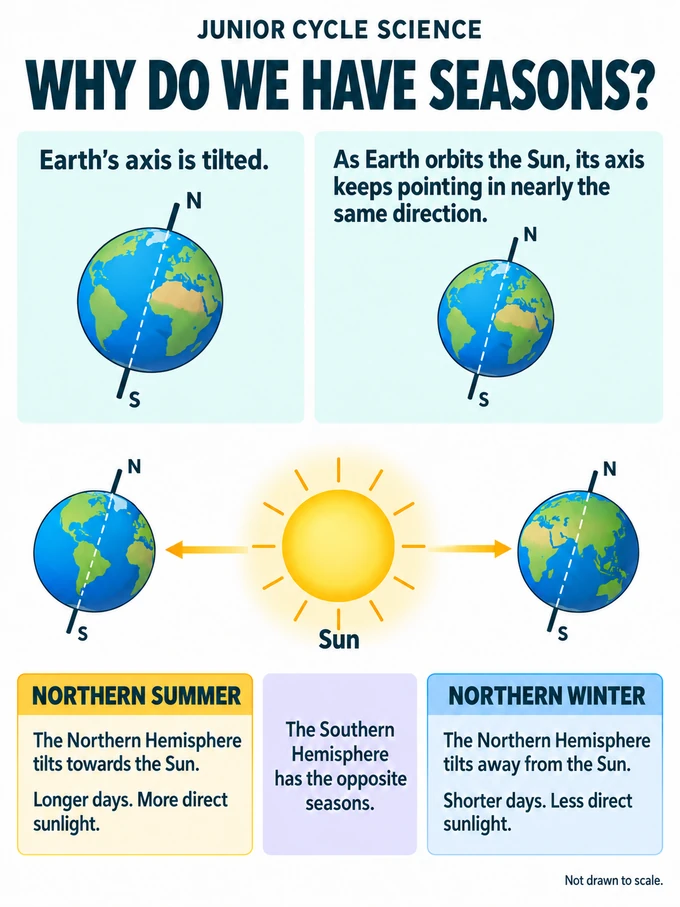
- Earth’s axis is tilted by about 23.5° from the upright position relative to its orbit.
- The axis keeps pointing in nearly the same direction during the year.
- Each hemisphere is tilted towards the Sun for part of the year and away for another part.
Why we have seasons
Seasons are caused by Earth’s tilt as it orbits the Sun.
- Northern summer: the Northern Hemisphere tilts towards the Sun. Days are longer and sunlight is more direct.
- More energy reaches each square metre, so the ground becomes warmer.
- The Southern Hemisphere tilts away at the same time and has winter.
- About six months later, the seasons reverse. Changing distance from the Sun is not the main cause.
Why the Moon changes shape
Moon phases are the different shapes of the sunlit Moon we see from Earth.
- The Moon reflects sunlight. The Sun normally lights half of it.
- As the Moon orbits Earth, we see different amounts of that sunlit half.
| Phase | What we see |
|---|---|
| New Moon | The sunlit half faces mostly away from us. |
| Crescent | A thin part of the sunlit half is visible. |
| First or last quarter | Half of the visible disc looks lit. |
| Full Moon | The whole visible disc looks lit. |
Eclipses
An eclipse happens when the Sun, Earth and Moon line up so that one body blocks sunlight.
- Lunar eclipse: Earth is between the Sun and Moon. Earth’s shadow falls on the Moon.
- Solar eclipse: the Moon is between Earth and the Sun. It blocks our view of the Sun from some places.
- The Moon’s orbit is tilted, so the bodies do not line up exactly every month.
- Ordinary Moon phases are caused by our changing view, not by Earth’s shadow.
Compare planets carefully
Check the quantity and unit before comparing planet data.
- Compare like with like: mass with mass, diameter with diameter.
- Surface gravity is the gravitational force on each kilogram near a planet’s surface.
- It depends on both mass and radius. Mass alone does not tell us the surface gravity.
- Your mass stays the same on another world. Your weight changes if the gravitational field strength changes.
03Worked examples
A person has a mass of 50 kg. Use a gravitational field strength of 10 N/kg on Earth and 1.6 N/kg on the Moon to find their weight.
Work through it
- Weight = mass × gravitational field strength.
- On Earth: 50 × 10 = 500 N.
- On the Moon: 50 × 1.6 = 80 N.
- The person has less weight on the Moon, but their mass is still 50 kg.
04Common mistakes
Common mistake
“Ireland has summer because Earth is closer to the Sun.”
Remember: Earth’s tilt gives Ireland longer days and more direct sunlight in summer. The Southern Hemisphere has winter at the same time.
Common mistake
“Earth’s shadow causes a crescent Moon.”
Remember: A crescent is our view of a small part of the Moon’s sunlit half. Earth’s shadow causes a lunar eclipse.
05Answering questions
- For seasons, link the tilted axis to both day length and sunlight angle. Keep the axes parallel in a two-position Earth–Sun diagram.
- For weight calculations, use weight = mass × gravitational field strength. Give weight in newtons and state that mass remains unchanged.
06Infographic & reference diagrams
07Try an investigation
Use a globe and lamp to model day, night and seasons. Keep the globe’s axis pointing in the same direction as you move it around the lamp. Use a small ball to model Moon phases. Do not shine the lamp into anyone’s eyes or use improvised filters to look at the Sun.
Do practical work with your teacher and follow the laboratory safety instructions.