By the end of this topic
- Describe uses of satellites and probes.
- Connect an instrument with the information it collects.
- Explain a benefit, a cost and an environmental concern about a space project.
01Key terms & definitions
- Satellite
- An object that orbits another body. It may be natural or made by people.
- Remote sensing
- Collecting information about something from a distance.
- Space probe
- A spacecraft without people on board that investigates space or another world.
- Orbit debris
- Old satellites, rocket parts and other unwanted objects or fragments left in orbit.
- Scientific benefit
- New scientific knowledge or a better way to investigate a question.
- Ethical question
- A question about fairness, responsibilities or what we should do.
02Understand the idea
Why explore space?
Space exploration helps us learn about Earth, the Solar System and the wider Universe.
- Some instruments travel into space; others observe from Earth.
- A telescope collects light from distant objects.
- A camera shows surface features; a temperature sensor measures temperature.
- Choose the instrument to match the question.
Satellites and probes
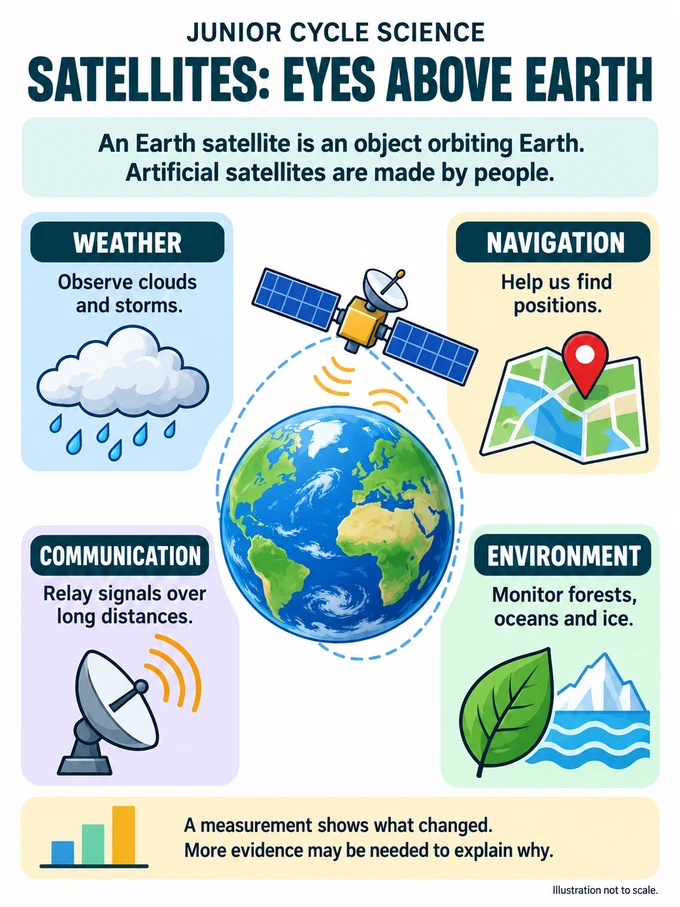
A satellite is an object that orbits another body.
- The Moon is a natural satellite of Earth.
- Artificial satellites are made and launched by people.
- A space probe is a spacecraft without people on board that investigates space or another world.
- A probe may fly past a planet, orbit it or land on its surface.
How satellites help us
| Use | What the satellite helps us do |
|---|---|
| Weather | Observe clouds and storms to help with forecasts. |
| Communication | Send signals for services such as television and internet connections. |
| Navigation | Find positions for maps, transport and emergency services. |
| Environmental research | Monitor changes in forests, oceans, ice and farmland. |
From a measurement to an explanation
Remote sensing means collecting information from a distance.
- A satellite image can show a field’s colour changing.
- Drought, disease or harvesting could explain the change.
- Rainfall records, soil measurements and visits to the field help distinguish these causes.
- Calibration means checking instruments against known values. It helps us judge how reliable the measurements are.
Benefits and costs
Compare a mission’s purpose, benefits, costs and alternatives.
- Benefits may include new knowledge, useful services or improved technology.
- Costs include money, materials and energy. Launches affect the environment, and equipment may fail.
- Ask who benefits and who carries the risks.
- These are ethical questions: questions about fairness, responsibilities and what we should do.
Space debris
Space debris includes old satellites, discarded rocket parts and fragments left in orbit.
- These objects travel quickly and can damage working spacecraft in a collision.
- Avoid creating unnecessary debris.
- Plan what happens to spacecraft at the end of their useful life to protect future missions and services.
Science is a team effort
Space projects involve scientists, engineers, technicians, computer specialists and others.
- Use reliable project records to find out what each team contributed.
- Give dates and distinguish planned work from completed results.
- Check the evidence before claiming an invention came from a particular space project.
03Worked examples
A satellite image shows that a green field has turned brown. Does this prove that drought caused the change?
Work through it
- Observation: the field’s colour has changed.
- Possible explanations include drought, disease and harvesting.
- Check rainfall and soil moisture, look for disease and find out whether the crop was harvested.
- Use this extra evidence to decide which explanation is best supported.
04Common mistakes
Common mistake
“All satellites are made by people.”
Remember: The Moon is a natural satellite of Earth. Artificial satellites are made by people.
Common mistake
“A brown field in a satellite image proves that drought caused the change.”
Remember: The image shows a change, but drought, disease or harvesting could explain it. More evidence is needed.
05Answering questions
- Link the mission question to an instrument and its measurement: for example, a temperature sensor provides readings to investigate surface temperature.
- For an evaluation, give a specific benefit and a specific cost or risk. Explain how each affects your recommendation instead of only saying “space exploration is useful”.
06Infographic & reference diagrams
07Try an investigation
Choose a space mission or satellite service with your teacher. Prepare a short report explaining its purpose, instruments, useful findings and one environmental or ethical issue. Include the sources and dates of your information.
Do practical work with your teacher and follow the laboratory safety instructions.