By the end of this topic
- Use pH to identify acidic, neutral and alkaline solutions.
- Describe how indicators work.
- Distinguish a base from an alkali.
- Write simple word equations for neutralisation.
01Key terms & definitions
- Acid
- A substance that produces hydrogen ions in water and forms a solution with pH below 7 at room temperature.
- Base
- A substance that reacts with and neutralises an acid.
- Alkali
- A base that dissolves in water.
- Indicator
- A substance that changes colour in acidic or alkaline solutions.
- pH
- A scale showing how acidic or alkaline a solution is.
- Neutralisation
- A reaction between an acid and a base.
02Understand the idea
Acids and bases
Acids and bases have different chemical properties. Lemon juice and vinegar are acidic; soap solution is alkaline.
- An acid produces hydrogen ions in water. An ion is a charged particle.
- A base reacts with and neutralises an acid.
- An alkali is a base that dissolves in water.
The pH scale
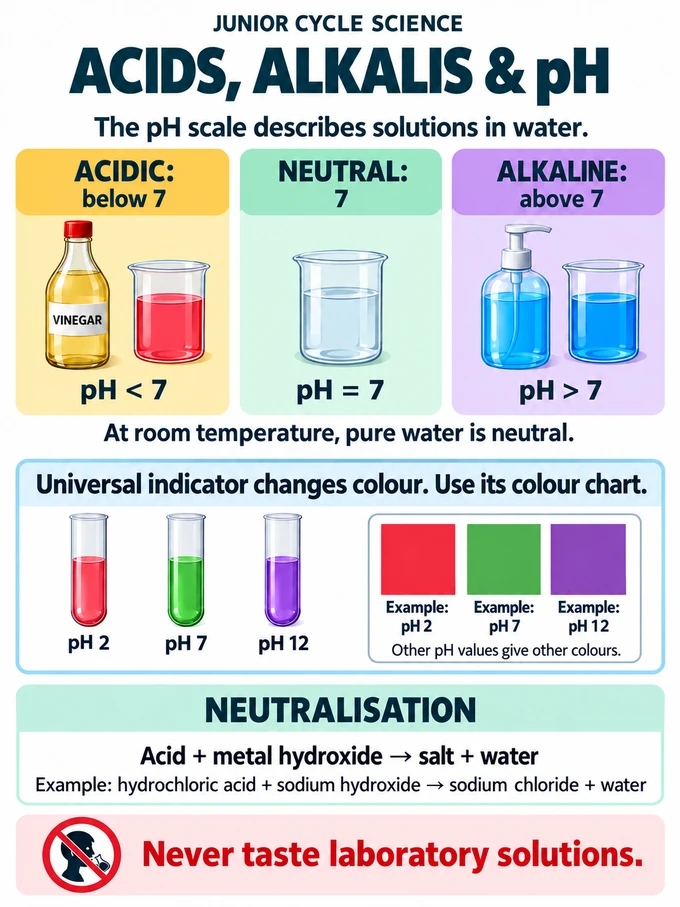
The pH scale tells us how acidic or alkaline a solution is. The usual school chart runs from 0 to 14. At room temperature, pH 7 is neutral.
| pH | Type of solution | Example |
|---|---|---|
| Below 7 | Acidic | Vinegar. |
| 7 | Neutral | Pure water. |
| Above 7 | Alkaline | Soap solution. |
Reading pH values
At room temperature, pH 7 is neutral. Values can include decimals.
- Lower pH means more acidic: pH 6.5 is acidic.
- Higher pH means more alkaline: pH 7.5 is alkaline.
- A pH meter gives a numerical reading; an indicator chart usually gives an approximate value or range.
Indicators change colour
An indicator changes colour in acidic or alkaline solutions.
- Litmus: red in acid; blue in alkali.
- Universal indicator: a range of colours matched to a pH chart.
- Typical colours: red/orange in strongly acidic solutions; green at neutral pH; blue/purple in alkaline solutions.
- Always use the chart supplied with the indicator.
Neutralisation
Neutralisation is a reaction between an acid and a base.
- Acid + metal hydroxide → salt + water.
- Hydrochloric acid + sodium hydroxide → sodium chloride + water.
- “Salt” names a group of compounds, not just table salt. Its name depends on the reactants.
Acids reacting with carbonates
An acid reacting with a carbonate also produces carbon dioxide.
- Acid + carbonate → salt + water + carbon dioxide.
- Hydrochloric acid + calcium carbonate → calcium chloride + water + carbon dioxide.
- The carbon dioxide turns limewater milky.
How much acid and alkali should react?
Adding alkali to acid moves the pH towards neutral. Too much alkali makes the mixture alkaline.
- Equal volumes do not always neutralise exactly: concentrations and reacting amounts matter.
- Use measured amounts and an indicator to follow the change.
- Everyday examples: antacids react with excess stomach acid; lime can reduce soil acidity.
03Worked examples
Write a word equation for the reaction between hydrochloric acid and sodium hydroxide.
Work through it
- Write the two reactants on the left: hydrochloric acid + sodium hydroxide.
- The products are sodium chloride and water.
- Complete the equation: hydrochloric acid + sodium hydroxide → sodium chloride + water.
04Common mistakes
Common mistake
“Every base is an alkali.”
Remember: An alkali is a base that dissolves in water. Some bases are insoluble.
Common mistake
“Equal volumes of acid and alkali always give a neutral mixture.”
Remember: The amounts that react depend on concentration and the substances used, not volume alone.
05Answering questions
- When interpreting pH, give both the value and classification: for example, pH 4 means acidic.
- Check the reaction type before writing products: acid + hydroxide gives salt and water; acid + carbonate also gives carbon dioxide.
06Infographic & reference diagrams
07Try an investigation
Use indicator to test labelled, dilute solutions chosen by your teacher. Compare each colour with the supplied chart. Wear eye protection, use separate droppers and never taste solutions or mix cleaning products.
Do practical work with your teacher and follow the laboratory safety instructions.