By the end of this topic
- Calculate power and energy.
- Calculate electrical power using voltage and current.
- Set clear design criteria and use fair tests to improve a device.
01Key terms & definitions
- Power
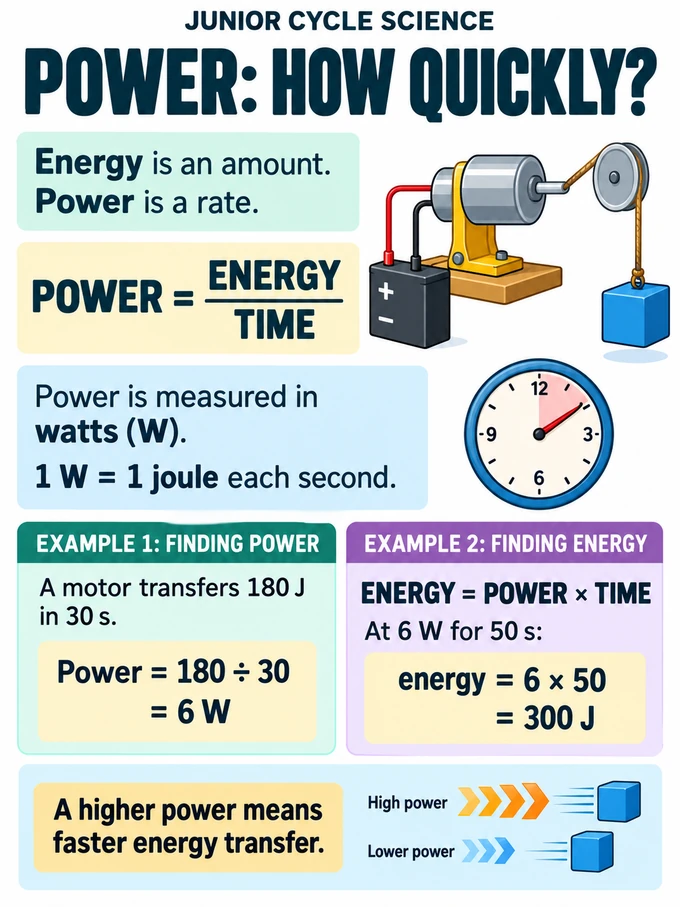
- Energy transferred each second. Measured in watts (W); 1 W = 1 J per second.
- Electrical power
- The rate of electrical energy transfer. Calculate it by multiplying voltage by current.
- Design criterion
- A measurable requirement that tells you whether a design does its job.
- Prototype
- A model built to test a design idea.
- Evaluation
- Comparing test results with what a design was meant to achieve.
- Improvement
- A change that makes a design work better, supported by the results of a new test.
02Understand the idea
What is power?
Power tells us how quickly energy is transferred.
- Power is measured in watts (W). One W = one joule transferred each second.
- Average power = energy transferred ÷ time taken.
- A motor transfers 180 J in 30 s: average power = 180 ÷ 30 = 6 W.
Power and energy are different
Energy is an amount. Power is the amount transferred each second.
- Energy = power × time.
- A 6 W motor running for 50 s transfers 6 × 50 = 300 J.
- A higher-power device transfers energy faster, but its running time also affects total energy use.
- A 10 W device running for 10 s and a 5 W device running for 20 s each transfer 100 J.
Electrical power
Electrical power = potential difference × current.
- Use volts and amps to obtain power in watts.
- For a lamp at 3 V and 0.4 A: power = 3 × 0.4 = 1.2 W.
- The lamp transfers 1.2 J of electrical energy each second.
Start a design with a clear job
Design criteria are measurable requirements that say what a device must do.
- Example: lift a 50 g load through 20 cm in less than 10 s.
- Agree limits such as materials, battery supply and load before building.
- Include safety as well as performance.
Build and test a prototype
A prototype is a model built to test an idea.
- Sketch the design and label the parts before building.
- Show the energy pathway: battery → motor → lifted load.
- Test against your criteria. Record the load, height and time.
- Repeat trials to check reliability. Record failures too: slipping string, friction or weak connections may explain them.
Change one thing and test again
Change one feature so you can tell whether it helps.
- Try a different pulley or a stronger support.
- Keep load, lifting height and supply conditions the same.
- Repeat the same test for both versions.
- If several things change at once, you cannot tell which caused an improvement.
Evaluate the result
Evaluation means comparing the results with what the device was meant to do.
- Use measurements to check each design criterion.
- Consider speed, energy use, reliability and safety together.
- A faster device might also use more energy or fail more often.
- Record a sketch, the results and a reason for the next improvement.
03Worked examples
power = energy transferredtime taken
A motor transfers 180 J in 30 s. Find its average power. Then find the energy it transfers in 50 s if it keeps the same power.
Work through it
- Power = energy ÷ time = 180 ÷ 30 = 6 W.
- Energy = power × time.
- In 50 s, energy = 6 × 50 = 300 J.
04Common mistakes
Common mistake
“Giving energy in watts and power in joules.”
Remember: Energy is measured in joules; power is measured in watts, or joules per second.
Common mistake
“Claiming a design is better because it worked once.”
Remember: Repeat comparable tests and check all the agreed design criteria, including safety and reliability.
05Answering questions
- Write down energy and time with their units before choosing power = energy ÷ time or energy = power × time.
- When evaluating a design change, quote a result and explain how it relates to a specific design criterion.
06Infographic & reference diagrams
07Try an investigation
Design a low-voltage device to lift a small load. Agree the load and height with your teacher. Sketch, build and test it, keeping moving parts clear of fingers. Change one feature and repeat the same test. Use the results to explain whether the change helped.
Do practical work with your teacher and follow the laboratory safety instructions.