By the end of this topic
- Compare renewable and non-renewable resources.
- Explain the greenhouse effect in clear steps.
- Distinguish weather from climate and mitigation from adaptation.
01Key terms & definitions
- Renewable resource
- An energy resource that nature replaces quickly enough for continued human use.
- Non-renewable resource
- An energy resource used much faster than nature replaces it.
- Greenhouse effect
- The warming caused when gases absorb infrared radiation and emit some of it back towards Earth’s surface.
- Climate
- The usual patterns of weather in a place over many years.
- Weather
- Conditions such as temperature, rain and wind at a particular place and time.
- Mitigation
- Action to reduce the causes of climate change, such as cutting greenhouse-gas emissions.
02Understand the idea
Energy resources
Energy resources supply energy for heating, transport and electricity. They can be renewable or non-renewable.
| Type | Meaning | Examples |
|---|---|---|
| Renewable | Naturally replaced quickly enough for continued human use. | Sunlight, wind and flowing water |
| Non-renewable | Used much faster than it is naturally replaced. Supplies are limited. | Coal, oil, natural gas and uranium |
Choosing an energy resource
Every energy resource has benefits and drawbacks.
- Wind turbines burn no fuel while generating electricity, but output changes with wind speed.
- Fossil-fuel power stations can supply electricity when needed, but burning fuel releases carbon dioxide.
- Compare cost, reliability, emissions, land use and habitat effects.
- Include making and maintaining equipment. Renewable resources still require materials and equipment.
Weather and climate
Weather is short-term; climate describes patterns over many years.
- Weather includes today’s rain, wind and temperature at a particular place.
- Climate describes the usual patterns of weather over many years.
- A cold week in Ireland is a weather event.
- Climate evidence includes long records from many places and changes in ice and ocean temperatures.
The natural greenhouse effect
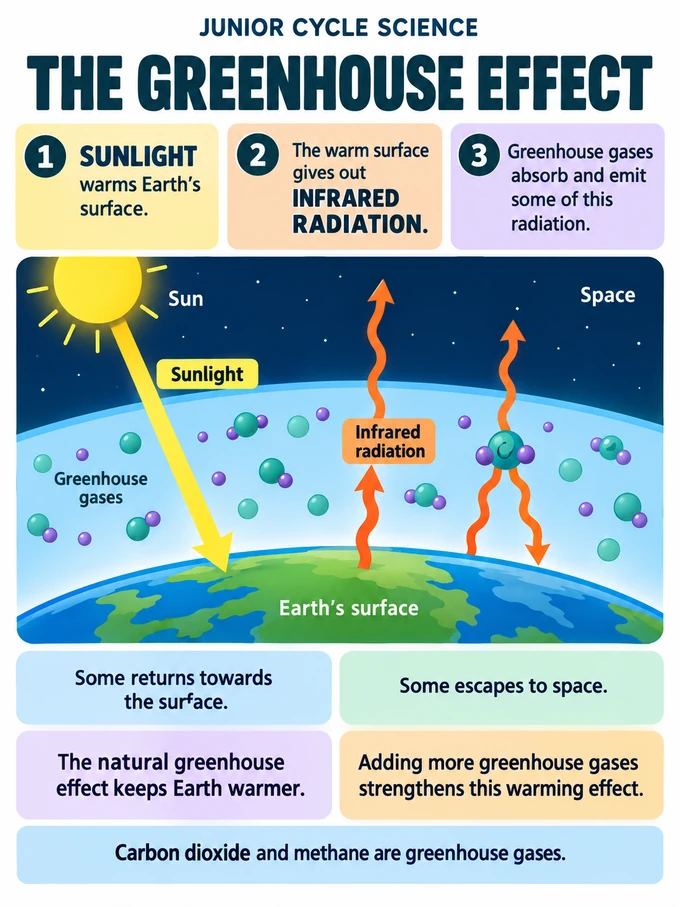
The natural greenhouse effect keeps Earth warmer than it would be without greenhouse gases.
- Sunlight warms Earth’s surface.
- The warm surface gives out infrared radiation, carrying energy away.
- Greenhouse gases absorb some infrared radiation and emit it in all directions.
- Some radiation returns towards the surface; some escapes to space.
- Greenhouse gases include carbon dioxide, methane and water vapour.
Why extra greenhouse gases cause warming
More greenhouse gases strengthen the greenhouse effect.
- Burning fossil fuels adds carbon dioxide. Some farming activities and other processes add methane.
- Extra greenhouse gases reduce the energy escaping to space at first. Earth gains energy and warms.
- As Earth warms, it gives out more infrared radiation. Energy still escapes to space.
- The warming affects rainfall, ice, sea level and living things.
Responding to climate change
Mitigation tackles the causes of climate change. Adaptation helps us cope with its effects.
| Response | Examples |
|---|---|
| Mitigation | Insulate buildings, use less fossil fuel and generate electricity from low-emission resources. |
| Adaptation | Improve flood defences, prepare for heatwaves and change farming methods to suit changed conditions. |
Read climate claims carefully
Check the timescale and evidence behind a climate claim.
- A single day, a few years and several decades answer different questions.
- Look for long records and more than one source of evidence.
- A climate projection describes what may happen under stated conditions.
- Future warming partly depends on greenhouse-gas emissions, so different emissions choices lead to different projections.
03Worked examples
A headline says, “This week was colder than last week, so the climate is cooling.” Is this conclusion supported?
Work through it
- The measurements compare two weeks, so they describe short-term weather.
- Climate describes patterns over many years. Compare long records, not only these two weeks.
- A cold week can happen during a long-term warming trend. The headline does not provide enough evidence for its conclusion.
04Common mistakes
Common mistake
“A cold week proves global warming has stopped.”
Remember: A cold week is local weather. Global warming is a long-term change studied using records from many places.
Common mistake
“Greenhouse gases form a lid that stops all energy escaping.”
Remember: They absorb and emit infrared radiation. Some returns towards Earth, but energy still escapes to space.
05Answering questions
- Explain the greenhouse effect in order: sunlight warms the surface → the surface emits infrared → greenhouse gases absorb and emit infrared → some returns towards the surface.
- When comparing energy resources, discuss the same features for both, such as reliability, emissions and habitat effects. Give a reason for your conclusion.
06Infographic & reference diagrams
07Try an investigation
Compare two energy resources using information selected with your teacher. Make a table of their benefits, drawbacks and environmental effects. Add one example of climate mitigation and one example of adaptation.
Do practical work with your teacher and follow the laboratory safety instructions.