By the end of this topic
- Describe the route food takes through the digestive system.
- Explain the roles of enzymes and bile.
- Explain how villi help absorption.
- Distinguish digestion, absorption and egestion.
01Key terms & definitions
- Digestion
- Breaking large food molecules into smaller molecules that the body can absorb.
- Mechanical digestion
- Breaking food into smaller pieces, for example by chewing.
- Chemical digestion
- Using chemical reactions to break large food molecules into smaller ones.
- Absorption
- Movement of digested nutrients through the gut wall into the blood or lymph.
- Villus
- A tiny finger-like projection in the small intestine that provides surface area for absorption.
- Egestion
- Passing undigested material out of the body as faeces.
02Understand the idea
Why do we need food?
Food supplies nutrients for energy, growth and repair. A balanced diet supplies a variety of nutrients, together with water and fibre.
| Nutrient or dietary component | Main role |
|---|---|
| Carbohydrates | Provide energy. |
| Proteins | Supply materials for growth and repair. |
| Fats | Store energy and form parts of cells. |
| Vitamins and minerals | Needed in small amounts for many body processes. |
| Fibre | Helps food and waste move through the gut. |
| Water | Needed for transport and chemical reactions. |
What is digestion?
Digestion breaks food down so that its nutrients can be absorbed and used by cells.
- Mechanical digestion breaks food into smaller pieces, for example by chewing.
- Chemical digestion breaks large food molecules into small, soluble molecules.
- Digestive enzymes speed up chemical digestion. For example, amylase breaks starch into sugars.
The journey through the digestive system
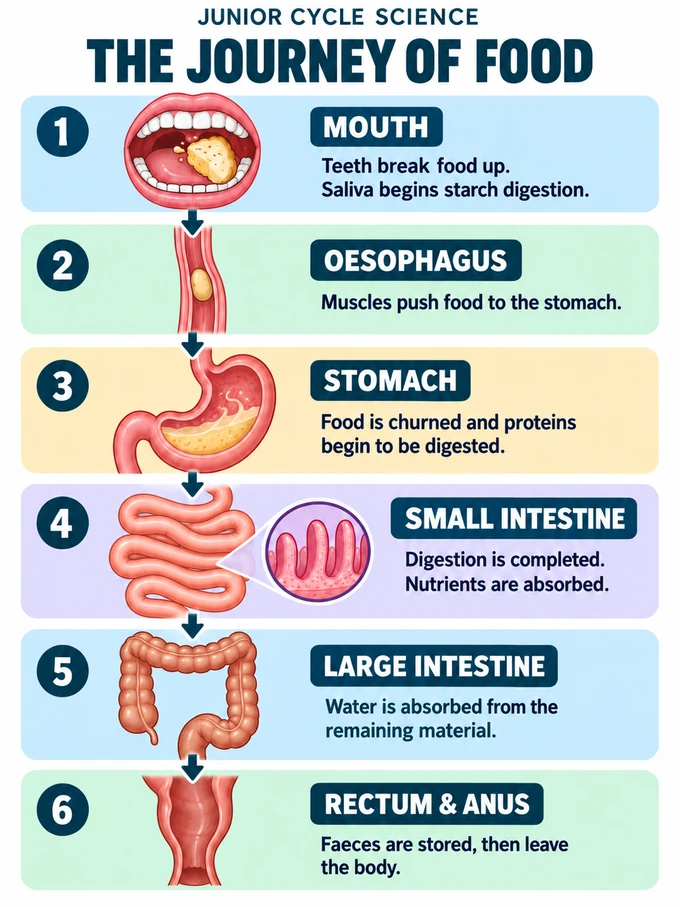
Food travels through the mouth, oesophagus, stomach, small intestine, large intestine, rectum and anus.
| Part | What happens there? |
|---|---|
| Mouth | Teeth break up food. Saliva contains amylase, which begins starch digestion. |
| Oesophagus | Muscular movements push food towards the stomach. |
| Stomach | Food is churned. Acid provides suitable conditions for a protein-digesting enzyme and kills many microbes. |
| Small intestine | Digestion is completed and nutrients are absorbed. |
| Large intestine | Water is absorbed from the remaining material. |
| Rectum and anus | Faeces are stored, then passed out of the body. |
Enzymes and bile
Different enzymes act on different food molecules. The pancreas releases digestive enzymes into the small intestine.
- Amylase breaks starch into sugars.
- Proteases break proteins into amino acids.
- Lipases break fats into fatty acids and glycerol.
- The liver makes bile; the gall bladder stores it. Bile is not an enzyme.
- Bile breaks large fat droplets into smaller ones, giving enzymes more surface to work on. It also helps neutralise acid from the stomach.
- Food does not pass through the liver or pancreas. These organs send substances into the gut.
Absorption in the small intestine
Absorption is the movement of digested nutrients through the wall of the small intestine. Many enter the blood. Most absorbed fats first enter vessels carrying lymph, then later reach the blood.
Tiny finger-like projections called villi help absorption:
- Many villi provide a large surface area.
- Their thin walls give nutrients a short distance to cross.
- Transport vessels carry absorbed nutrients away to the body’s cells.
What happens to the nutrients and waste?
Absorbed nutrients supply cells with energy and materials.
- Glucose is used in respiration to release energy.
- Amino acids are used to make proteins for growth and repair.
- Some nutrients are stored for later use.
- Egestion removes undigested material as faeces.
- Excretion removes waste made by the body’s chemical reactions, such as carbon dioxide.
03Worked examples
Consider a piece of bread. Chewing breaks it into pieces, but enzymes are needed to break its starch into small sugar molecules that can be absorbed.
Work through it
- Teeth break the bread into smaller pieces, exposing more surface.
- Amylase and other digestive enzymes break starch down into small sugars.
- The small sugars cross the small-intestine wall.
- The circulation carries nutrients to cells, where they can be used.
04Common mistakes
Common mistake
“Digestion and absorption are the same process.”
Remember: Digestion breaks food molecules down. Absorption moves digested nutrients through the gut wall.
Common mistake
“Bile is an enzyme.”
Remember: Bile breaks fat into smaller droplets and helps neutralise acid. Digestive enzymes carry out chemical breakdown.
05Answering questions
- When explaining villi, link each feature to absorption: large area, short distance through the wall and transport away.
- When tracing food, follow the gut route. Mention the liver and pancreas as organs that add substances, not places food passes through.
06Infographic & reference diagrams
07Try an investigation
Follow the path of food on a digestive-system model. In a teacher-supervised enzyme investigation, compare starch samples under controlled conditions. Do not taste laboratory food samples.
Do practical work with your teacher and follow the laboratory safety instructions.