By the end of this topic
- Identify the main reproductive organs and their roles.
- Distinguish fertilisation from implantation.
- Describe the menstrual cycle without assuming fixed timing.
- Explain the placenta’s role in exchange.
01Key terms & definitions
- Gamete
- A sex cell, such as a sperm or an egg.
- Fertilisation
- The joining of sperm and egg nuclei to form a zygote.
- Implantation
- The embedding of an early embryo in the lining of the uterus.
- Placenta
- The organ through which a developing baby receives oxygen and nutrients and loses wastes.
- Ovulation
- The release of an egg from an ovary.
- Menstrual cycle
- The repeating changes in the ovaries and uterus, including ovulation and menstruation.
02Understand the idea
Sexual reproduction in humans
Human sexual reproduction involves two gametes, or sex cells: a sperm and an egg. When their nuclei join, genetic information from both parents is combined. This event is called fertilisation.
The fertilised egg, called a zygote, divides to form an embryo. The reproductive organs produce the gametes and provide the route and conditions for development.
The male reproductive system
The male reproductive organs produce sperm and carry them out of the body.
- Testes: produce sperm and testosterone. The scrotum holds them outside the main body cavity.
- Epididymis: sperm mature and are stored here.
- Sperm ducts: carry sperm away from the testes.
- Glands add fluid to sperm, forming semen.
- The urethra carries semen out through the penis. It also carries urine, but not normally at the same time.
The female reproductive system
| Structure | Role |
|---|---|
| Ovary | Contains egg cells and produces hormones. An egg is released at ovulation. |
| Oviduct | Carries an egg towards the uterus. Fertilisation usually occurs here. |
| Uterus | A muscular organ where an embryo can implant and develop. |
| Cervix | The narrow lower part of the uterus, opening into the vagina. |
| Vagina | The passage leading from the cervix to the outside of the body. |
Puberty and the menstrual cycle
Puberty is the stage when hormones cause the body to mature towards reproductive adulthood. Changes can include body-hair growth, breast development, voice changes, sperm production and the start of periods. Timing varies between people.
During the menstrual cycle:
- The lining of the uterus builds up.
- An egg may be released from an ovary: ovulation.
- If pregnancy does not occur, the lining breaks down and leaves through the vagina as a period.
- Cycle length and ovulation timing vary. A fixed day on a classroom diagram cannot predict someone’s fertility.
Fertilisation and implantation
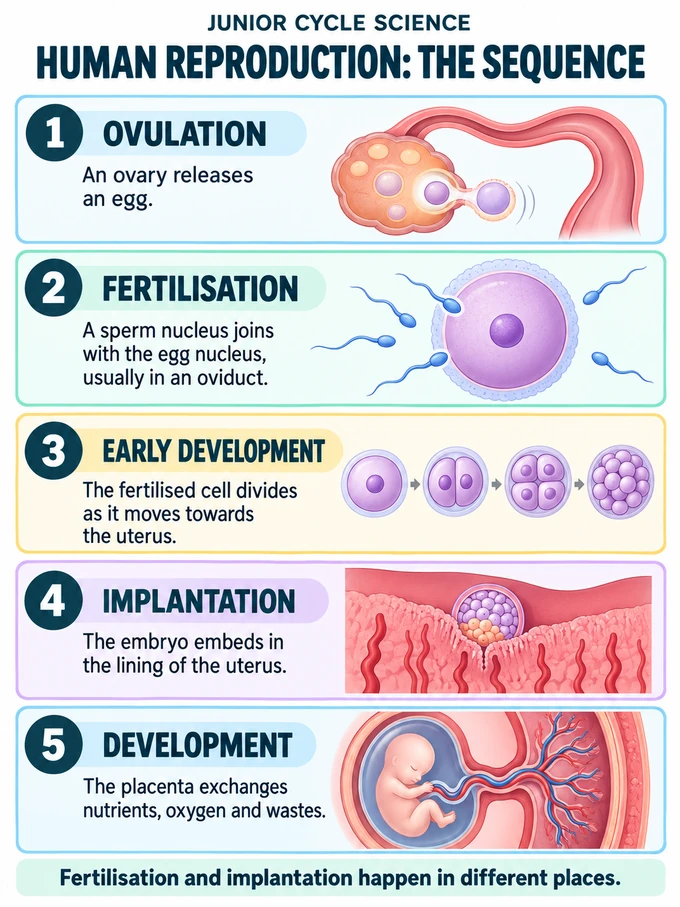
Fertilisation usually happens in an oviduct when a sperm nucleus joins with an egg nucleus. The resulting cell divides as it travels towards the uterus.
The early embryo then attaches to and becomes embedded in the uterus lining. This is implantation. Fertilisation and implantation are different events in different places.
The placenta and development
The placenta allows exchange between the mother and developing baby. The umbilical cord connects the baby to the placenta.
- Oxygen and nutrients pass towards the baby.
- Carbon dioxide and other wastes pass towards the mother for removal.
- The two blood supplies do not normally mix directly.
- Some harmful substances and infections can cross the placenta; it is not a complete protective barrier.
Reproductive health and questions for society
Contraception aims to prevent pregnancy. Preventing pregnancy and reducing the spread of sexually transmitted infections are different tasks. Use the school’s current health resources when comparing particular methods.
Fertility treatment can help some people have a baby, but it does not always succeed. Questions about cost and access involve both scientific evidence and people’s values. In discussing them, distinguish what the treatment does from what people think should be available.
These topics can be discussed using fictional examples. Respect privacy and use the class’s confidential question route if you prefer.
03Worked examples
Follow the sequence from an egg being released to an embryo developing in the uterus.
Work through it
- An ovary releases an egg: ovulation.
- If a sperm joins with the egg in an oviduct, fertilisation occurs.
- The fertilised cell divides as it moves towards the uterus.
- The embryo embeds in the uterus lining: implantation.
Another example
- Sperm route: testis → epididymis → sperm duct → urethra → outside through the penis.
- Egg route: ovary → oviduct. Fertilisation may occur in the oviduct.
- An early embryo can then travel to the uterus and implant in its lining.
04Common mistakes
Common mistake
“Fertilisation and implantation happen in the same place.”
Remember: Fertilisation usually occurs in an oviduct. Implantation occurs later in the uterus lining.
Common mistake
“Everyone has the same menstrual-cycle timetable.”
Remember: Cycle length and ovulation timing vary, so a fixed day on a classroom diagram is not an individual prediction.
05Answering questions
- For a reproduction sequence, name the event and its usual location, then put the events in order.
- When describing the placenta, give the direction of exchange: oxygen and nutrients towards the baby; carbon dioxide and other wastes towards the mother.
06Infographic & reference diagrams
07Try an investigation
Use labelled models to identify the organs and trace the routes of sperm and egg cells. Discuss supplied fictional examples using current school-approved reproductive-health resources.
Do practical work with your teacher and follow the laboratory safety instructions.