By the end of this topic
- Describe photosynthesis and write its word equation.
- Describe aerobic respiration and write its word equation.
- Explain why plants need both processes.
- Interpret an investigation into a factor affecting photosynthesis.
01Key terms & definitions
- Photosynthesis
- The process in which plants use light energy to make glucose from carbon dioxide and water.
- Aerobic respiration
- Chemical reactions that use oxygen to release energy from nutrients.
- Chloroplast
- A plant-cell structure containing chlorophyll, where photosynthesis happens.
- Limiting factor
- The factor that is holding back the rate of a process.
- Glucose
- A simple sugar used in respiration and to make other substances.
- Net gas exchange
- The overall gas movement after taking all gas-producing and gas-using processes into account.
02Understand the idea
How plants make food
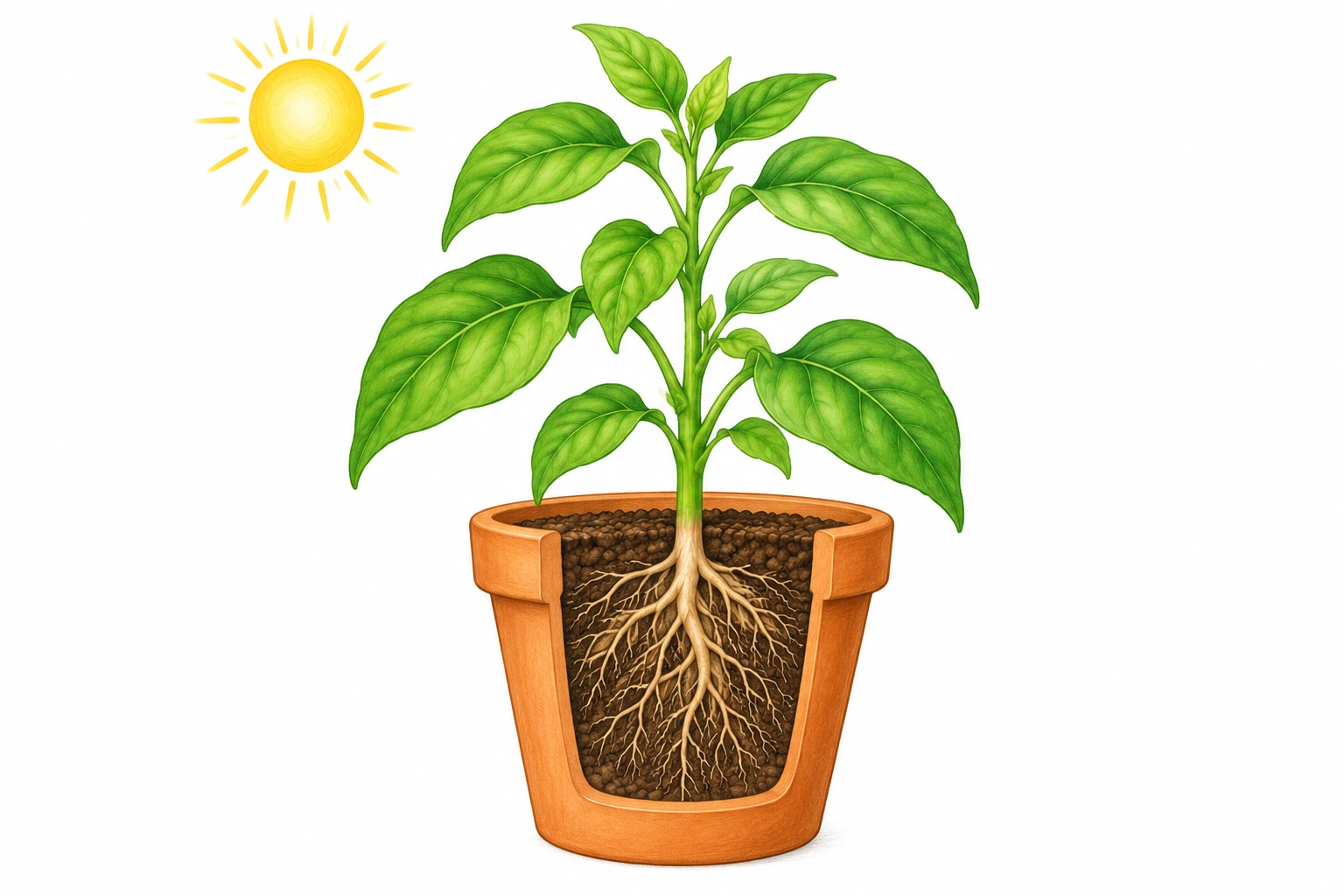
Green plants make glucose, a sugar, by photosynthesis. Light supplies the energy.
- Inputs: carbon dioxide from the air and water absorbed by roots.
- Outputs: glucose and oxygen.
- Location: chloroplasts contain chlorophyll, the green substance that absorbs light.
- Glucose can be used in respiration, stored as starch or used to make other plant materials.
The photosynthesis equation
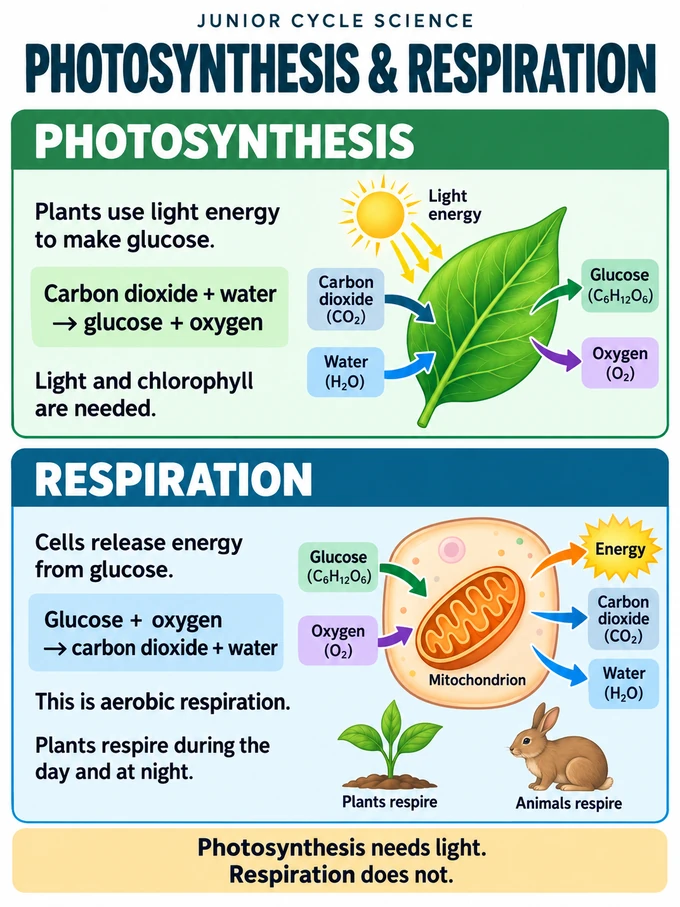
The word equation is: carbon dioxide + water → glucose + oxygen. Light and chlorophyll are needed.
The balanced chemical equation is: 6CO₂ + 6H₂O → C₆H₁₂O₆ + 6O₂.
Photosynthesis transfers light energy into a chemical energy store. Plants do not create energy. Minerals from the soil are needed for healthy growth, but they do not replace the food made by photosynthesis.
What is respiration?
Respiration is a series of chemical reactions in cells that releases usable energy from nutrients. In aerobic respiration, glucose reacts with oxygen.
The word equation is: glucose + oxygen → carbon dioxide + water. Energy is released for cell activities, including growth and repair.
Both plant and animal cells carry out respiration. Living plant cells respire during the day and at night.
Plants carry out both processes
Plants photosynthesise and respire at the same time in the light. Net gas exchange means the overall gas movement after both processes are taken into account.
- Bright light: photosynthesis may make more oxygen than respiration uses, so oxygen leaves overall.
- Darkness: photosynthesis stops, but respiration continues. Oxygen enters and carbon dioxide leaves.
- Balance point: oxygen production equals oxygen use. There is no net oxygen exchange, even though both processes continue.
What affects the rate of photosynthesis?
The rate of photosynthesis depends on light intensity, carbon dioxide supply and temperature. A limiting factor is the factor holding the rate back.
- More light helps only while light is limiting the rate.
- If carbon dioxide is in short supply, adding more light may have little effect.
- Very high temperatures can damage enzymes and reduce the rate.
Investigating photosynthesis
A pondweed investigation can test how changing the distance from a lamp affects gas production.
- Count bubbles over the same time interval at each distance.
- Keep other factors, such as temperature and pondweed length, as similar as possible.
- Allow the plant to adjust before counting, then repeat readings.
- Bubbles vary in size and some gas dissolves. Measuring collected gas volume can give more useful information.
- A leaf starch test can show that starch has been made and stored. Follow your teacher’s supervised procedure when using hot water or ethanol.
03Worked examples
In a simple example, photosynthesis produces 8 units of oxygen per minute while respiration uses 3. The plant releases 5 units of oxygen per minute overall.
Work through it
- Oxygen produced = 8 units per minute.
- Oxygen used = 3 units per minute.
- Subtract: 8 − 3 = 5 units per minute released.
- Both photosynthesis and respiration are taking place.
04Common mistakes
Common mistake
“Plants respire only at night.”
Remember: Living plant cells respire during the day and at night. Photosynthesis can hide oxygen use by producing more oxygen overall.
Common mistake
“Plants get all their food from the soil.”
Remember: Plants make glucose from carbon dioxide and water using light. Soil supplies water and minerals, not ready-made glucose.
05Answering questions
- Keep the two word equations separate and state which process uses light and which releases usable energy.
- For a graph that levels off, suggest a possible limiting factor. Explain that the graph alone may not identify which factor it is.
06Infographic & reference diagrams
07Try an investigation
Use a teacher-supervised pondweed investigation or supplied results to test one factor affecting photosynthesis. Repeat readings and explain why bubble counts are only an estimate of gas production.
Do practical work with your teacher and follow the laboratory safety instructions.