By the end of this topic
- Identify producers, consumers and decomposers.
- Explain the direction of food-chain arrows.
- Explain how decomposers help recycle matter.
- Distinguish matter recycling from energy flow.
01Key terms & definitions
- Ecosystem
- Living organisms and their non-living surroundings interacting together.
- Producer
- An organism that makes its own food, usually using light energy.
- Consumer
- An organism that gets food by eating other organisms or their products.
- Decomposer
- An organism that breaks down dead organisms and waste.
- Food web
- Several food chains linked together.
- Energy flow
- The transfer of energy through an ecosystem and out to the surroundings.
02Understand the idea
What is an ecosystem?
An ecosystem includes living organisms and the non-living surroundings with which they interact.
- A pond ecosystem includes plants, animals and microbes.
- Water, light and temperature are non-living parts of the ecosystem.
- Organisms depend on one another for food and other resources.
Producers, consumers and decomposers
| Group | How it obtains food |
|---|---|
| Producer | Makes its own food. Green plants use light energy in photosynthesis. |
| Consumer | Feeds on other organisms or their products. A rabbit eats plants; a fox eats animals. |
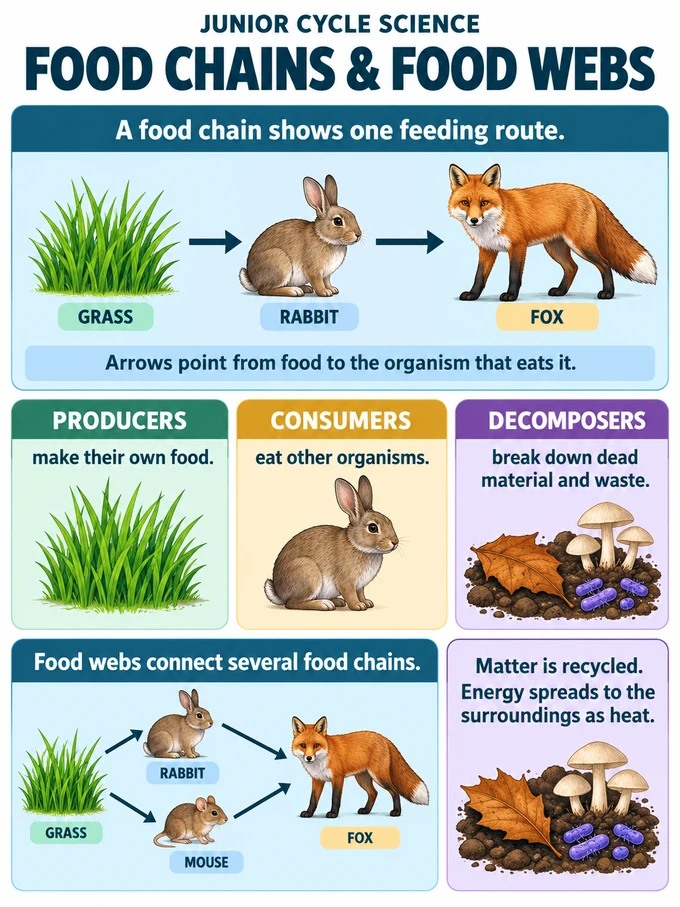
| Decomposer | Breaks down dead organisms and waste. Many fungi and bacteria do this. |
Reading a food chain
A food chain shows one feeding route: grass → rabbit → fox.
- Arrows point from the food to the organism that eats it.
- They show the direction in which matter and energy pass.
- The rabbit is a herbivore: it eats plants.
- The fox is a carnivore: it eats animals.
Food webs show more connections
A food web joins several food chains together.
- Most organisms have more than one food source. A fox may eat rabbits, mice and other animals.
- If rabbit numbers fall, foxes have less of that food and some plants may be eaten less.
- The result also depends on other food sources, competition, disease and habitat conditions.
Matter is recycled
Decomposers break down dead organisms and waste, helping recycle matter.
- Mineral nutrients return to soil or water and can be taken up by plants.
- Carbon moves between organisms and their surroundings.
- Plants absorb minerals from soil, but make their food by photosynthesis. They do not get their food by eating soil.
Energy flows through an ecosystem
In a green-plant food chain, light provides the starting energy.
- Plants store some light energy in food. Feeding transfers some of this energy to consumers.
- Organisms use energy in life processes. Much energy eventually spreads to the surroundings as heat.
- Some material is left uneaten or passes out as waste.
- Only part of the energy becomes new tissue available to the next consumer.
- Matter is recycled. Energy is not completely recycled, so these ecosystems need a continuing supply of light energy.
Calculating an energy-transfer percentage
To find the percentage of input energy transferred into growth:
- Identify the energy stored in the new growth.
- Divide it by the stated input energy, then multiply by 100.
- Use the values in the question. The percentage is not the same in every food chain.
03Worked examples
Plant material supplies 1000 kJ. Of this, 80 kJ becomes new herbivore tissue. The growth-transfer percentage is 8%.
Work through it
- Identify the input: 1000 kJ.
- Identify the energy stored in new tissue: 80 kJ.
- Calculate 80 ÷ 1000 × 100 = 8%.
- The remaining energy has other routes; it has not been destroyed.
04Common mistakes
Common mistake
“A food-chain arrow points towards the food being eaten.”
Remember: It points from food to consumer: grass → rabbit shows the rabbit eating the grass.
Common mistake
“Decomposers recycle all the energy back to plants.”
Remember: They help recycle matter. Much energy spreads to the surroundings as heat and is not recycled through the food web.
05Answering questions
- For a food-web change, follow a specific feeding link and explain a possible effect. Avoid assuming one fixed outcome for every population.
- For an energy-transfer percentage, identify the stated input and output, divide output by input and multiply by 100.
06Infographic & reference diagrams
07Try an investigation
Build a food web from supplied information or a local habitat study. Label what the arrows mean. Predict how one change might affect two other populations and explain each link.
Do practical work with your teacher and follow the laboratory safety instructions.