By the end of this topic
- Describe the particles in a solid, liquid and gas.
- Explain melting, freezing, boiling and evaporation.
- Use melting and boiling points to identify a state.
- Explain why mass is conserved.
01Key terms & definitions
- Particle model
- An explanation of matter using tiny moving particles.
- Solid
- A state of matter with a fixed shape and volume.
- Liquid
- A state of matter with a fixed volume but no fixed shape.
- Gas
- A state of matter with no fixed shape or volume.
- Physical change
- A change in which no new substance is made.
- Closed system
- A system that matter cannot enter or leave.
02Understand the idea
Matter is made of particles
Matter is anything that has mass and takes up space. Air, water and everyday objects are all matter.
- Matter is made of tiny particles, too small to see with your eyes.
- The particle model explains matter using particles that move and have spaces between them.
- Their arrangement and movement explain the properties of solids, liquids and gases.
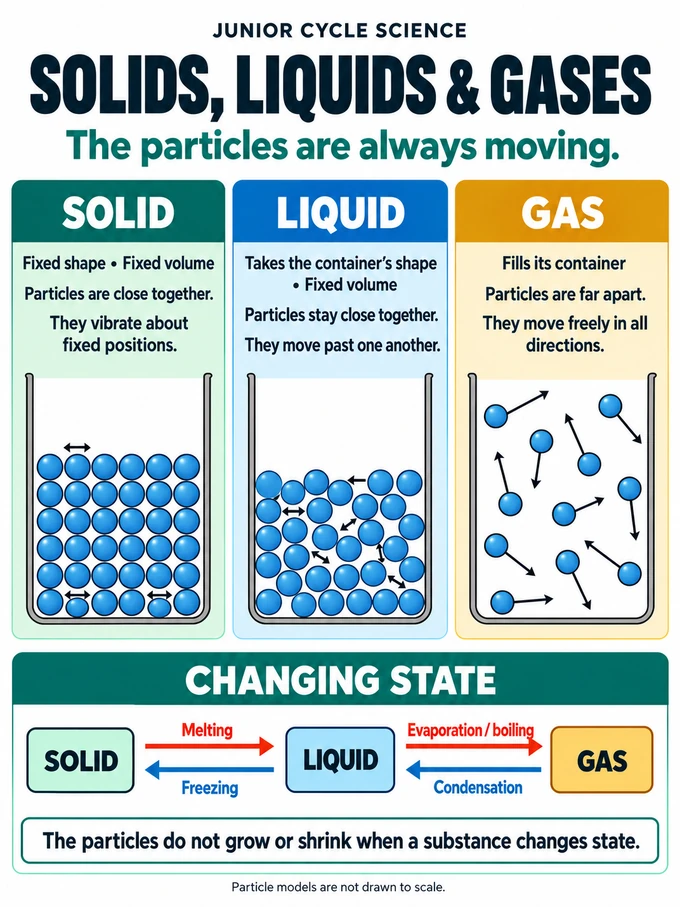
Solids, liquids and gases
| State | What the particles do | What we observe |
|---|---|---|
| Solid | Stay close together and vibrate about fixed positions. | Has a fixed shape and volume. |
| Liquid | Stay close together but move past one another. | Has a fixed volume and takes the shape of its container. |
| Gas | Are far apart and move freely in all directions. | Spreads out to fill its container. |
Why is a gas easy to compress?
Compressing means squeezing something into a smaller space.
- Gases: large spaces between particles allow the particles to be pushed closer together.
- Solids and liquids: particles are already close together, so these states are difficult to compress.
Changing state
Heating transfers energy to a substance. Its particles do not grow or shrink when it changes state.
- As a solid warms, its particles vibrate more. During melting, they leave their fixed positions and move past one another.
- Melting: solid → liquid.
- Freezing: liquid → solid.
- Boiling or evaporation: liquid → gas.
- Condensation: gas → liquid.
Evaporation and boiling
Both evaporation and boiling change a liquid into a gas.
- Evaporation happens at the surface and can occur below the boiling point. It dries a wet jumper.
- Boiling happens throughout the liquid at its boiling point. Bubbles form inside the liquid.
- Pure water boils at about 100 °C at normal air pressure.
Melting and boiling points
Different substances have different melting and boiling points. The table uses normal air pressure.
- Below the melting point: solid.
- Between the melting and boiling points: liquid.
- Above the boiling point: gas.
| Substance | Melting point | Boiling point |
|---|---|---|
| Water | 0 °C | 100 °C |
| Ethanol | −114 °C | 78 °C |
| Aluminium | 660 °C | 2519 °C |
What happens on a heating curve?
A heating curve shows temperature as a substance is heated.
- Sloping sections: temperature rises.
- Flat sections can show melting or boiling.
- During a change of state, energy changes particle arrangement or separation.
- For a pure substance at constant pressure, temperature stays constant until the change of state is complete.
Matter does not disappear
Conservation of mass means that total mass stays the same when no matter enters or leaves.
- Physical change: no new substance forms. Melting ice is still water.
- Chemical change: new substances form, but atoms are still present.
- If gas escapes from an open container, the measured mass falls because matter has left.
03Worked examples
A container and its contents have a total mass of 146.2 g. A change takes place inside it, but no matter enters or leaves. What is the total mass afterwards?
Work through it
- The mass before the change is 146.2 g.
- All the particles stay inside, including any gas produced.
- The total mass afterwards is therefore 146.2 g.
Another example
- Ethanol melts at −114 °C and boils at 78 °C at normal air pressure.
- 20 °C lies between these two temperatures.
- Ethanol is therefore a liquid at 20 °C.
04Common mistakes
Common mistake
“Particles get bigger when a substance is heated.”
Remember: The particles themselves do not get bigger. Their movement and separation can change.
Common mistake
“Evaporation happens only at the boiling point.”
Remember: Evaporation happens at the liquid surface and can occur below its boiling point.
05Answering questions
- For a particle explanation, describe arrangement, spacing and movement—not just what the substance looks like.
- To identify a state from data, compare the stated temperature with both the melting and boiling points.
06Infographic & reference diagrams
07Try an investigation
Observe ice melting and record its temperature at regular intervals. Plot temperature against time. For a conservation-of-mass reaction, use teacher-supplied data or approved gas-collection equipment. Never seal a gas-producing reaction in a rigid container.
Do practical work with your teacher and follow the laboratory safety instructions.