By the end of this topic
- Identify reactants and products.
- Describe tests for oxygen, hydrogen and carbon dioxide.
- Explain how temperature, concentration, surface area and catalysts affect reaction rate.
- Calculate an average reaction rate.
01Key terms & definitions
- Chemical reaction
- A change that rearranges atoms to make new substances.
- Reactant
- A substance present at the start of a chemical reaction.
- Product
- A substance made in a chemical reaction.
- Reaction rate
- How quickly a chemical reaction happens.
- Catalyst
- A substance that speeds up a reaction without being used up overall.
- Enzyme
- A biological catalyst that speeds up reactions in living things.
02Understand the idea
Chemical reactions make new substances
A chemical reaction makes new substances by rearranging atoms.
- Reactants: starting substances. Products: substances made.
- The same types and numbers of atoms are present before and after.
- Word equation: reactants → products.
Signs of a reaction
Observations can suggest a reaction, but consider the substances involved too.
- Possible signs: colour change, temperature change, gas production or a new solid.
- A precipitate is a solid formed when solutions react.
- Bubbles alone do not prove a reaction: boiling water is a physical change.
Reactions that produce gases
Here are three examples of reactions studied in the laboratory. The arrow means “reacts to form”.
- Magnesium + hydrochloric acid → magnesium chloride + hydrogen.
- Calcium carbonate + hydrochloric acid → calcium chloride + water + carbon dioxide.
- Hydrogen peroxide → water + oxygen.
Identifying a gas
Different gases give different test results. These tests are carried out with small samples under teacher supervision.
| Gas | Test | Positive result |
|---|---|---|
| Oxygen | Use a glowing splint. | The splint relights. |
| Hydrogen | Use a lit splint at the mouth of a test tube. | A squeaky pop is heard. |
| Carbon dioxide | Bubble the gas through limewater. | The limewater turns milky. |
Reaction rate
Reaction rate tells us how quickly a reaction happens.
- For a gas-producing reaction, measure the volume collected over a given time.
- Average rate = gas volume ÷ time; a possible unit is cm³/s.
- A faster reaction produces more gas in the same time.
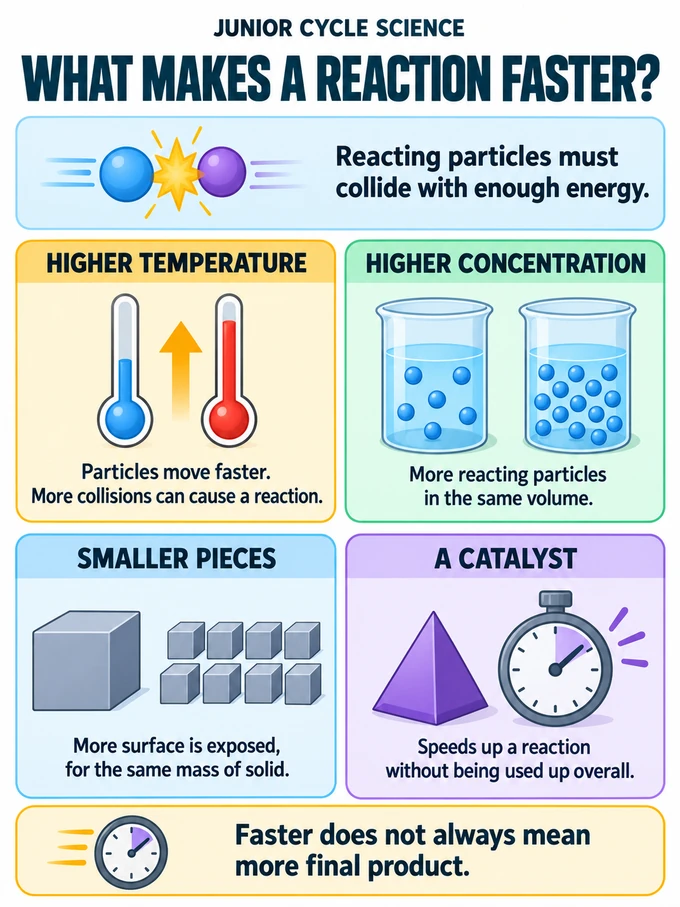
- Two reactions can make the same final amount but finish at different times. Faster does not necessarily mean more product.
Why do temperature and concentration matter?
Reacting particles must collide with enough energy for a reaction to happen.
- Higher temperature: particles move faster, collide more often and more collisions have enough energy. Rate usually increases.
- Higher concentration: more reacting particles in the same volume, so collisions happen more often and the reaction is often faster.
Why do smaller pieces react faster?
Breaking a solid into smaller pieces exposes more surface to the other reactant.
- Smaller marble chips react faster than one large piece of the same total mass.
- Keep acid concentration and temperature the same for a fair comparison.
Catalysts and enzymes
A catalyst speeds up a reaction without being used up overall.
- It provides a reaction route needing less activation energy.
- An enzyme is a biological catalyst, such as those involved in digestion.
- Catalase speeds up the breakdown of hydrogen peroxide.
- Enzymes work within a suitable temperature range. Excess heat changes their shape so they no longer work properly: this is denaturing.
03Worked examples
A reaction produces 48 cm³ of gas in the first 24 seconds. Find its average rate over this time.
Work through it
- Write the relationship: average rate = gas volume ÷ time.
- Substitute the values: average rate = 4824.
- The average rate is 2 cm³/s over the first 24 seconds.
Another example
- A glowing splint relights in a sample of gas.
- This is the positive test for oxygen.
- Hydrogen is tested with a lit splint; carbon dioxide is tested with limewater.
04Common mistakes
Common mistake
“A faster reaction must produce more product overall.”
Remember: Rate is how quickly product forms. Reactions can finish at different times but produce the same final amount.
Common mistake
“Any bubbles prove that a chemical reaction has happened.”
Remember: Boiling also makes bubbles. Use the substances involved and other evidence to decide whether new substances formed.
05Answering questions
- For a gas-test answer, name the test and its positive result: for example, carbon dioxide turns limewater milky.
- For average rate, write volume ÷ time, substitute the values and include a matching unit such as cm³/s.
06Infographic & reference diagrams
07Try an investigation
Use gas-volume and time results to compare a reaction using large chips with one using small chips of the same substance. Keep the mass, acid concentration and temperature the same. Gas tests and flame tests must be supervised by your teacher.
Do practical work with your teacher and follow the laboratory safety instructions.