By the end of this topic
- Describe the main blood components and their jobs.
- Compare arteries, veins and capillaries.
- Trace blood through the heart, lungs and body.
- Explain how circulation links digestion and respiration.
01Key terms & definitions
- Artery
- A blood vessel that carries blood away from the heart.
- Vein
- A blood vessel that carries blood towards the heart.
- Capillary
- A tiny, thin-walled blood vessel where substances pass between blood and cells.
- Red blood cell
- A blood cell that carries oxygen using haemoglobin.
- Plasma
- The liquid part of blood that carries cells and dissolved substances.
- Double circulation
- The two linked routes of blood: heart to lungs and heart to body.
02Understand the idea
Why do we need a circulatory system?
Body cells need oxygen and nutrients. They also produce wastes, including carbon dioxide. The circulatory system transports these substances around the body.
The system consists of the heart, blood and blood vessels. The heart is a muscular pump that keeps blood moving.
What is in blood?
| Component | Job |
|---|---|
| Red blood cells | Carry oxygen using a substance called haemoglobin. |
| White blood cells | Help defend the body against infection. |
| Platelets | Help blood clot at a damaged blood vessel. |
| Plasma | The liquid that carries blood cells and dissolved substances, including nutrients and wastes. |
Three types of blood vessel
| Vessel | Direction and function |
|---|---|
| Artery | Carries blood away from the heart. Thick, strong walls withstand high pressure. |
| Vein | Carries blood towards the heart. Many veins have valves that prevent backflow. |
| Capillary | A tiny vessel with a very thin wall. Substances pass between blood and nearby cells. |
The heart has four chambers
The heart has four chambers. Its structures keep blood moving along the correct routes.
- Atria: the two upper chambers receive blood.
- Ventricles: the two lower chambers pump blood away.
- Valves prevent blood flowing backwards.
- The septum separates the right and left sides.
- The left ventricle has a thicker muscular wall because it pumps blood around the body. The right ventricle pumps blood the shorter distance to the lungs.
Follow the blood around the body
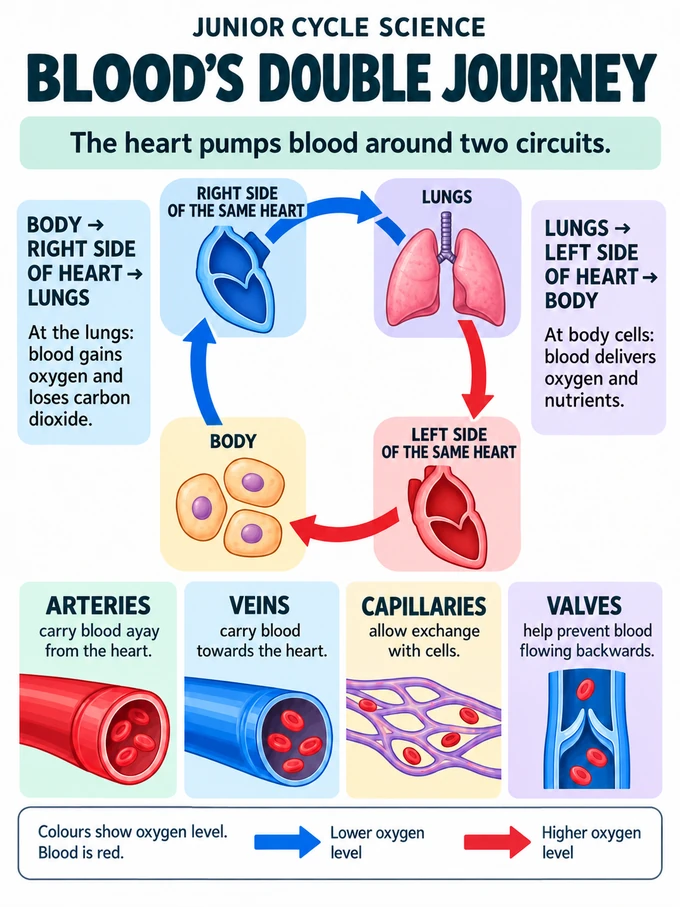
Blood passes through the heart twice on a complete journey around the lungs and body. This is called double circulation.
- Body → vena cava → right atrium → right ventricle.
- Right ventricle → pulmonary artery → lungs.
- Lungs → pulmonary veins → left atrium → left ventricle.
- Left ventricle → aorta → body.
Picking up and delivering oxygen
Blood picks up substances in one place and delivers them elsewhere.
- At the lungs, oxygen enters the blood and carbon dioxide leaves it. Oxygen-rich blood returns to the left side of the heart.
- At body tissues, oxygen and nutrients move from blood to cells. Carbon dioxide moves into the blood, which returns to the right side of the heart.
- The pulmonary artery carries oxygen-poor blood away from the heart to the lungs. An artery is defined by flow direction, not oxygen content.
- Blue on a diagram marks oxygen-poor routes. Human blood is red.
Linking the body systems
The digestive, breathing and circulatory systems work together.
- The digestive system supplies absorbed nutrients.
- The lungs supply oxygen.
- The blood delivers both to cells, where respiration releases energy.
- A pulse is the pressure wave in arteries caused by the beating heart. Pulse rate usually rises during activity, but one reading does not show overall health or fitness.
03Worked examples
Trace a red blood cell from the body to the lungs and back to the body. It passes through the right side of the heart before reaching the lungs and the left side afterwards.
Work through it
- Blood returns from the body to the right atrium, then the right ventricle.
- The right ventricle pumps it through the pulmonary artery to the lungs.
- It picks up oxygen and returns through the pulmonary veins to the left atrium.
- The left ventricle pumps it through the aorta to the body.
04Common mistakes
Common mistake
“All arteries carry oxygen-rich blood.”
Remember: Arteries carry blood away from the heart. The pulmonary artery carries oxygen-poor blood to the lungs.
Common mistake
“Blood shown in blue on a diagram is blue inside the body.”
Remember: Human blood is red. Diagram colours distinguish routes with different oxygen levels.
05Answering questions
- Trace a blood route one step at a time, using arrows and checking whether each vessel goes towards or away from the heart.
- Link vessel structure to function: for example, thin capillary walls give substances a short distance to cross.
06Infographic & reference diagrams
07Try an investigation
Use a heart model or labelled diagram to trace the direction of blood flow. Compare supplied pulse readings before and after gentle activity, without treating them as a medical test.
Do practical work with your teacher and follow the laboratory safety instructions.