By the end of this topic
- Combine forces and state the resultant direction.
- Explain balanced and unbalanced forces.
- Calculate weight and pressure.
01Key terms & definitions
- Force
- A push or pull that can change an object’s motion or shape. Measured in newtons (N).
- Resultant force
- The overall force when all the forces on an object are combined.
- Balanced forces
- Forces that give a resultant of zero. The object’s velocity does not change.
- Weight
- The force of gravity on an object. Weight = mass × gravitational field strength.
- Friction
- A force between touching surfaces that opposes sliding or the start of sliding.
- Pressure
- Force acting at right angles to a surface divided by its area. Measured in pascals (Pa).
02Understand the idea
What is a force?
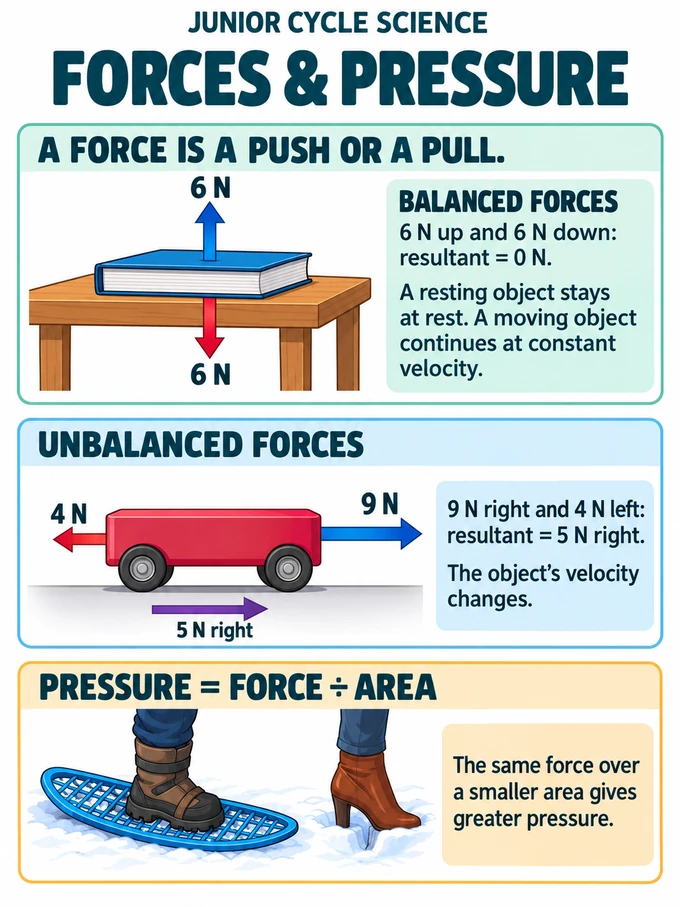
A force is a push or a pull.
- A force can change an object’s speed, direction or shape.
- Measure force with a force meter in newtons (N).
- Forces act when objects interact: a hand pushes a door, Earth pulls a ball, and a stretched spring pulls back.
Drawing forces
Represent a force with an arrow on the object it acts on.
- Point the arrow in the force’s direction and label its name or size.
- For a book on a table, weight acts downwards and the table’s support force acts upwards.
- Force arrows show pushes and pulls, not the direction of movement.
Balanced and unbalanced forces
The resultant force is the overall force when the forces on an object are combined.
- Same direction: add the forces. Opposite directions: subtract the smaller from the larger.
- Balanced forces: resultant = 0 N. An object stays at rest or continues at constant velocity.
- Unbalanced forces: the object’s velocity changes.
- Example: 9 N right and 4 N left give a resultant of 5 N right.
Friction
Friction acts between surfaces and opposes sliding or the start of sliding.
- Friction slows a box sliding across a floor and helps bicycle brakes work.
- Friction also lets shoes grip the ground without slipping.
- For a cyclist moving at constant velocity, the forward driving force balances friction and air resistance.
Mass and weight
Mass and weight are different quantities.
- Mass: the amount of matter in an object, measured in kilograms (kg).
- Weight: the force of gravity on an object, measured in newtons (N).
- Weight = mass × gravitational field strength, g.
- If g = 10 N/kg, a 0.6 kg object weighs 0.6 × 10 = 6 N.
- On the Moon, the same object has the same mass but a smaller weight because gravity is weaker.
Pressure: spreading out a force
Pressure tells us how concentrated a force is on a surface.
- Pressure = force acting at right angles to the surface ÷ contact area.
- For the same force, a smaller area gives greater pressure. A narrow knife edge produces high pressure.
- A larger area gives lower pressure. Snowshoes spread a person’s weight over a larger area.
- Use force in N and area in m² for pressure in pascals (Pa). One Pa = one N per m².
Forces can stretch a spring
A spring’s extension is its increase in length.
- Extension = new length − original length.
- For small loads, extension is proportional to force: doubling the force doubles the extension.
- Too much force can stretch a spring permanently.
03Worked examples
pressure = forcearea
An object has a mass of 0.6 kg. Use g = 10 N/kg to find its weight. Then find the pressure if this weight acts over an area of 0.003 m².
Work through it
- Calculate weight: 0.6 × 10 = 6 N.
- Divide the force by the area: 6 ÷ 0.003 = 2000 Pa.
- The weight is 6 N; the pressure on the surface is 2000 Pa.
Another example
- A trolley is pulled with 9 N to the right and 4 N to the left.
- The forces oppose each other, so subtract: 9 − 4 = 5 N.
- The resultant is 5 N to the right, in the direction of the larger force.
04Common mistakes
Common mistake
“Saying balanced forces always mean an object is stopped.”
Remember: They mean no change in velocity. The object may be moving steadily in a straight line.
Common mistake
“Giving weight in kilograms.”
Remember: Kilograms measure mass. Weight is a force measured in newtons.
05Answering questions
- For a resultant, show whether you add or subtract and give the final direction.
- In pressure explanations, identify both force and contact area. Use area in m² when calculating pressure in Pa.
06Infographic & reference diagrams
07Try an investigation
Measure a spring’s original length. Add small loads, measure the new lengths and calculate each extension. Plot force against extension. Keep loads within your teacher’s limit and clear of feet. Compare pressure by placing different faces of a block on foam.
Do practical work with your teacher and follow the laboratory safety instructions.