By the end of this topic
- Trace the route of air into the lungs.
- Explain breathing in and breathing out.
- Explain how alveoli help gas exchange.
- Distinguish breathing from respiration.
01Key terms & definitions
- Ventilation
- Movement of air into and out of the lungs.
- Gas exchange
- Movement of oxygen and carbon dioxide between the lungs and the blood.
- Alveolus
- A tiny air sac in the lungs where gases pass between air and blood.
- Diffusion
- The overall movement of particles from a higher concentration to a lower concentration.
- Diaphragm
- The sheet of muscle below the lungs that helps move air in and out.
- Respiration
- Chemical reactions in cells that release usable energy from nutrients.
02Understand the idea
Why do we breathe?
Breathing moves air into and out of the lungs. It brings in oxygen and removes carbon dioxide. The movement of air is also called ventilation.
Cells use oxygen in aerobic respiration, which releases energy from food. Respiration produces carbon dioxide. The blood carries oxygen from the lungs to cells and returns carbon dioxide to the lungs.
The route air takes
Air enters through the nose or mouth. Its route through the lungs becomes more finely branched:
- Trachea: the windpipe carrying air towards the lungs.
- Bronchi: the two branches of the trachea, one leading to each lung.
- Bronchioles: smaller branches inside the lungs.
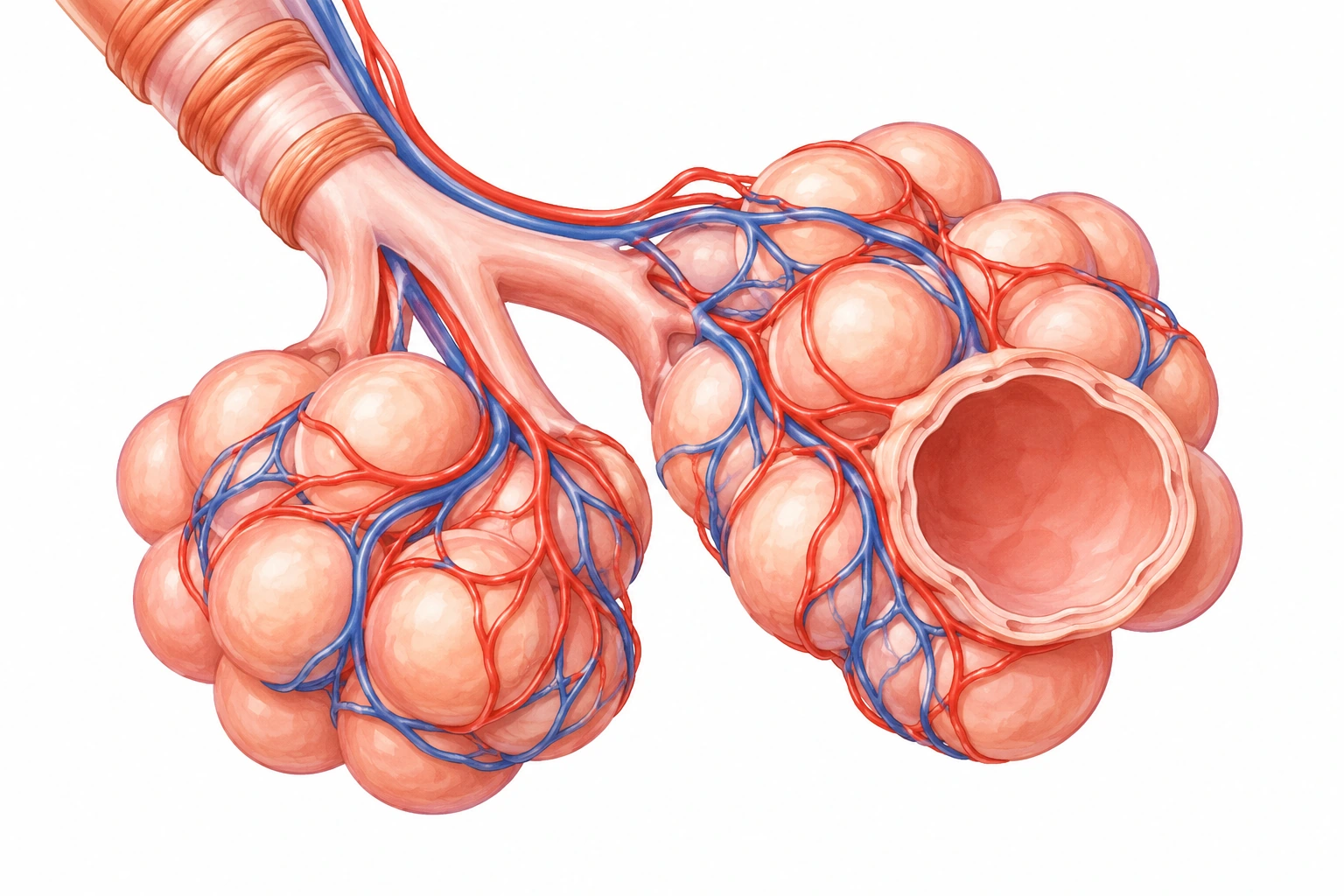
- Alveoli: tiny air sacs at the ends of the bronchioles. One air sac is an alveolus.
Breathing in
The diaphragm is a sheet of muscle below the lungs. During breathing in:
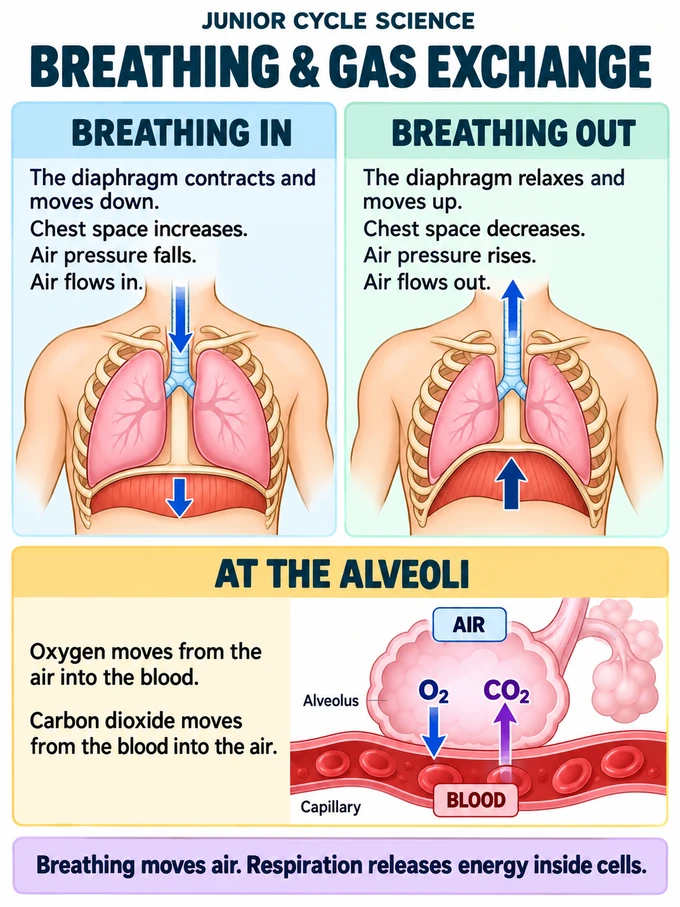
- The diaphragm contracts, flattens and moves down.
- Muscles between the ribs move the ribcage up and out.
- The space in the chest increases, so the lungs expand.
- Air pressure inside the lungs falls below outside air pressure. Air flows in.
Breathing out
During normal, quiet breathing out:
- The diaphragm relaxes and moves upwards.
- The ribcage moves down and in, and the lungs spring back towards their smaller size.
- The space inside the lungs decreases.
- Air pressure rises above outside air pressure, so air flows out.
Gas exchange at the alveoli
Alveoli are surrounded by tiny blood vessels called capillaries. Oxygen moves from the air in the alveoli into the blood. Carbon dioxide moves from the blood into the alveoli and is breathed out.
These gases move by diffusion: overall, particles move from where their concentration is higher to where it is lower.
- Many alveoli provide a large surface area.
- The alveolar and capillary walls are very thin, so gases have only a short distance to cross.
- Blood flow carries oxygen away and brings more carbon dioxide.
- Breathing replaces the air, keeping oxygen available.
What changes during exercise?
Active muscles need more energy, so their rate of respiration increases.
- Muscles use more oxygen and produce more carbon dioxide.
- Breathing rate and heart rate usually rise to help meet this demand.
- Exhaled air still contains oxygen. It contains less oxygen and more carbon dioxide than inhaled air.
Breathing and respiration are different
Breathing is the physical movement of air. Respiration is a series of chemical reactions inside cells. Breathing, gas exchange and blood circulation work together to supply those cells with oxygen.
03Worked examples
In a bell-jar lung model, pulling the rubber sheet down makes the balloons expand. The model shows how changing the space around the lungs changes air pressure.
Work through it
- Pull the rubber sheet down to increase the space inside the jar.
- Air pressure inside falls below the outside pressure.
- Air enters the balloons and they expand.
- The model does not show the movement of real ribs.
04Common mistakes
Common mistake
“Breathing is the same as respiration.”
Remember: Breathing moves air. Respiration releases energy through chemical reactions inside cells.
Common mistake
“Exhaled air contains only carbon dioxide.”
Remember: Exhaled air still contains oxygen and other gases. It has less oxygen and more carbon dioxide than inhaled air.
05Answering questions
- Explain breathing with a cause-and-effect chain: muscle movement → volume change → pressure change → airflow.
- For gas exchange, name both the gas and its direction: oxygen from alveoli to blood; carbon dioxide from blood to alveoli.
06Infographic & reference diagrams
07Try an investigation
Use a teacher-approved lung model to explain breathing. Compare supplied breathing-rate data before and after activity. Use teacher-planned alternatives if an activity is unsuitable for you.
Do practical work with your teacher and follow the laboratory safety instructions.