By the end of this topic
- Explain biodiversity and give examples of ecosystem services.
- Describe how food production can affect habitats.
- Compare benefits and costs of a proposed change.
- Suggest how to monitor the result.
01Key terms & definitions
- Biodiversity
- The variety of genes, species and ecosystems.
- Ecosystem service
- A benefit people receive from natural ecosystems.
- Pollination
- The transfer of pollen from an anther to a stigma, allowing fertilisation to follow in flowering plants.
- Sustainable production
- Producing what people need while protecting resources and ecosystems for the future.
- Habitat loss
- The destruction or change of places that organisms need to live.
- Evidence-based decision
- A choice supported by relevant observations, measurements and other reliable information.
02Understand the idea
What is biodiversity?
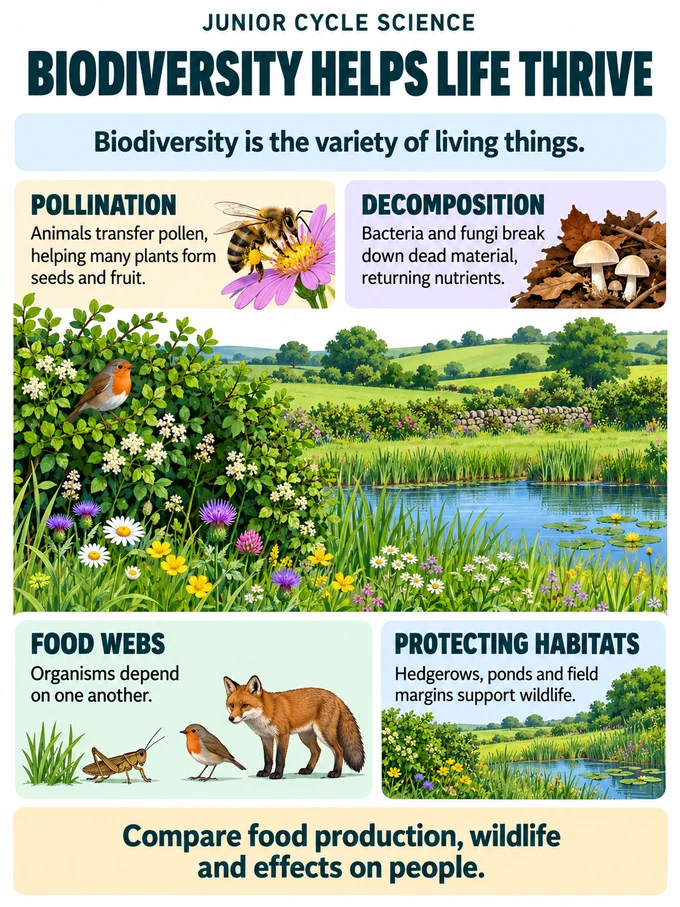
Biodiversity is the variety of living things. It includes variety at three levels:
- Within a species: for example, different apple varieties.
- Between species: for example, many kinds of insects and birds.
- Between ecosystems: for example, hedgerows, grassland and ponds.
Why does biodiversity matter?
Organisms form connected food webs. They also carry out processes that people depend on. These benefits are called ecosystem services.
| Service | Why it matters |
|---|---|
| Pollination | Insects and other animals transfer pollen, helping many crops form seeds and fruit. |
| Decomposition | Decomposers return nutrients to soil. |
| Pest control | Predators can reduce the numbers of some crop pests. |
| Soil protection | Plant roots help hold soil in place. |
Food production changes habitats
Farming and fishing provide food and support livelihoods. They also change the environment.
- Removing a hedgerow creates more cropped space but removes food and shelter for wildlife.
- Fertilisers improve crop growth, but nutrients washed into water can harm aquatic ecosystems.
- Pesticides control pests but may also harm other organisms.
- Fishing methods differ in the species they catch and the damage they cause to habitats.
Protecting biodiversity while producing food
Sustainable production meets today’s needs while protecting resources and ecosystems for the future. It also considers the people producing and using the food. Useful actions depend on the place and problem.
- Maintain hedgerows and protect watercourses.
- Use appropriate amounts of fertiliser.
- Reduce unwanted catches in fishing.
- Keep different crop varieties and livestock breeds. Their genetic variation can help food production respond to disease and changing conditions.
Comparing choices fairly
Yield is the amount of a crop or other product obtained, often measured per hectare. High yield matters, but it does not tell us everything.
- Compare food produced, wildlife recorded and water quality.
- Consider resources used, cost and effects on livelihoods.
- Compare similar areas and use more than one season, because weather and other conditions vary.
Making a recommendation
A useful recommendation identifies a practical change and explains how to check its effects. For example, a flowering field margin could help pollinators.
- State the proposed change and use evidence to explain its expected benefit.
- Identify a possible cost, such as less land available for crops.
- Suggest monitoring: use the same pollinator-counting method over several seasons and also record crop yield.
03Worked examples
A farm is considering keeping a flowering field margin. It could provide food for pollinators but use land that might otherwise grow crops.
Work through it
- Define the change: keep a flowering strip around the field.
- Identify a possible benefit: more flowers for pollinating insects.
- Identify a possible cost: less land growing the crop.
- Compare pollinator records and crop yield over several seasons using consistent methods.
04Common mistakes
Common mistake
“Biodiversity means only the number of species.”
Remember: It also includes variation within species and the variety of ecosystems.
Common mistake
“The method with the highest yield is always the most sustainable.”
Remember: Also compare effects on wildlife, water, resources, costs and livelihoods over time.
05Answering questions
- Support a recommendation with a specific benefit, a possible cost and a way to monitor the result.
- When comparing surveys or farms, check that the areas, sampling effort and conditions are reasonably comparable.
06Infographic & reference diagrams
07Try an investigation
Research a local or supplied food-production example. Propose one practical improvement, explain the evidence behind it and say how you would check whether it worked.
Do practical work with your teacher and follow the laboratory safety instructions.