By the end of this topic
- Describe the stages in a product’s lifecycle.
- Distinguish reducing, reusing and recycling.
- Make a fair comparison of two products.
01Key terms & definitions
- Lifecycle
- The stages a product goes through, from obtaining raw materials to reuse, recycling or disposal.
- Raw material
- A resource used to make a product, such as timber or metal ore.
- Reuse
- Using an item again without breaking it down into raw material.
- Recycling
- Processing waste material to make new products.
- Biodegradation
- Breakdown of a material by living organisms.
- Trade-off
- A choice where gaining one benefit means giving up another.
02Understand the idea
The lifecycle of a product
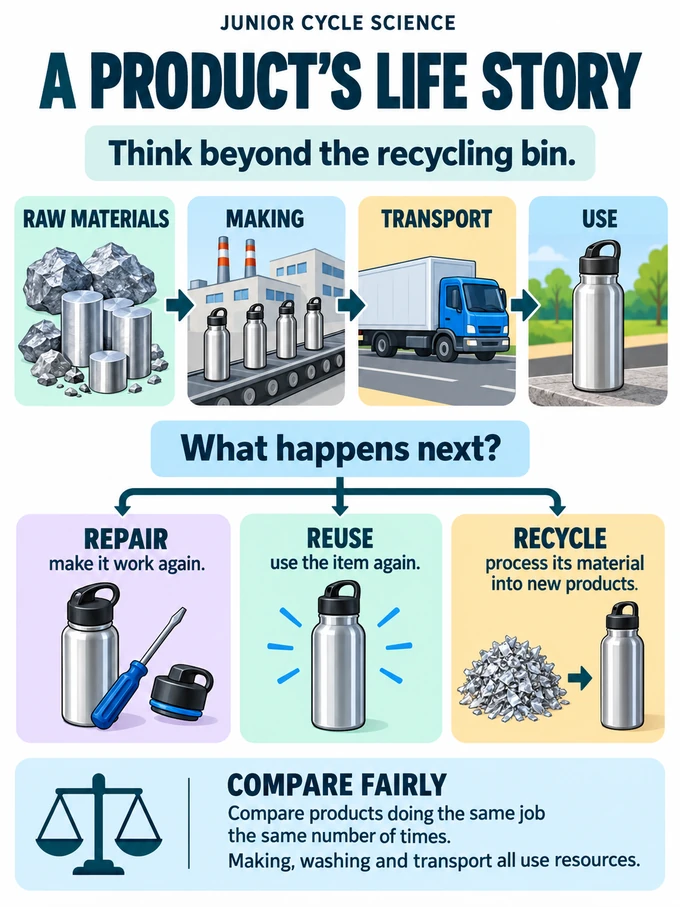
A product’s lifecycle runs from raw materials to reuse, recycling or disposal. Each stage can use resources and affect the environment.
- Obtain raw materials, such as aluminium ore.
- Process the materials and manufacture the product, such as a can.
- Transport and use the product.
- Repair, reuse, recycle or dispose of it.
Reducing and reusing
Reducing and reusing can help avoid waste.
- Reduce: use fewer materials. Buy only what is needed and choose less packaging.
- Reuse: use the item again without breaking it into raw material. Refill a bottle or repair a bag.
Recycling
Recycling processes waste material to make new products, such as melting old aluminium cans into new metal products.
- It can reduce demand for new raw materials.
- Collection, transport and processing still use energy.
- Local recycling depends on the material and the collection system.
Biodegradable materials
Biodegradable materials can be broken down by organisms such as bacteria and fungi. Food scraps are an example.
- Breakdown needs suitable conditions, including moisture and temperature.
- Some products need industrial composting conditions.
- “Biodegradable” does not mean a product quickly breaks down wherever it is dropped.
Comparing disposable and reusable products
Compare products doing the same job over the same number of uses.
- A reusable bottle may use more resources to make than one disposable bottle, but it can be used many times.
- Example: compare carrying the same amount of water on 100 days.
- Include the reusable bottle’s manufacture, washing and transport, and all disposable bottles needed for those days.
Making a decision using evidence
A sound decision uses evidence from the whole lifecycle.
- Look for data on manufacture, transport, use and disposal.
- Check what an advertisement’s measurements actually compare.
- Consider trade-offs: a stronger container may last longer but require more material.
- State evidence for your choice and identify important missing information.
03Worked examples
In a simple example, a disposable cup has an environmental impact of 4 units per use. A reusable cup costs 40 impact units to make and 1 unit to wash after each use. Compare 20 uses.
Work through it
- Disposable cups: 20 × 4 = 80 impact units.
- Reusable cup: 40 + (20 × 1) = 60 impact units.
- The reusable cup has the lower total in this example. A real comparison would also need evidence about transport, washing and disposal.
04Common mistakes
Common mistake
“Reuse and recycling mean the same thing.”
Remember: Reuse keeps the item in use; recycling processes its material into new products.
Common mistake
“A biodegradable item quickly breaks down anywhere.”
Remember: Breakdown needs suitable conditions. Some materials require industrial composting.
05Answering questions
- Compare products doing the same job over the same number of uses; include manufacture, transport, use and disposal.
- Support a choice with evidence, explain a trade-off and identify missing information instead of claiming one material is always best.
06Infographic & reference diagrams
07Try an investigation
Choose a familiar product, such as a drinks container. Draw its lifecycle and compare it with an alternative that does the same job. Record where your information came from and check your local collection guidance for the disposal stage.
Do practical work with your teacher and follow the laboratory safety instructions.