By the end of this topic
- Find an element’s name, symbol and atomic number.
- Identify groups and periods on the periodic table.
- Count atoms in a chemical formula.
- Use ion charges to work out simple compound formulae.
01Key terms & definitions
- Atomic number
- The number of protons in an atom’s nucleus.
- Mass number
- The total number of protons and neutrons in one atom.
- Group
- A vertical column in the periodic table.
- Period
- A horizontal row in the periodic table.
- Chemical formula
- Symbols and small numbers that show which elements are present and their amounts.
- Subscript
- A small number after a symbol or bracket that tells you how many atoms or groups are represented.
02Understand the idea
What is the periodic table?
The periodic table is a chart of the chemical elements.
- Each box shows an element’s name, symbol and atomic number.
- Atomic number = number of protons.
- Elements are arranged by increasing atomic number: hydrogen has 1 proton; helium has 2.
Groups and periods
The position of an element helps us predict how it behaves.
- Group: a vertical column. Modern groups are numbered 1–18.
- Period: a horizontal row.
- Elements in the same group often have similar properties.
- Group 1 includes the reactive metals lithium, sodium and potassium.
- Group 18 contains the very unreactive noble gases.
Electrons and patterns
In a simple atom diagram, electrons are arranged in shells around the nucleus.
- For the first 20 elements: put up to 2 electrons in the first shell, 8 in the second and 8 in the third before starting the fourth.
- Sodium: 11 electrons arranged 2, 8, 1. Chlorine: 17 electrons arranged 2, 8, 7.
- Outer electrons help explain reactions. Group 1 has one; group 2 has two; group 17 has seven.
- Occupied shells give the period. Sodium has three occupied shells, so it is in period 3.
Reading a chemical formula
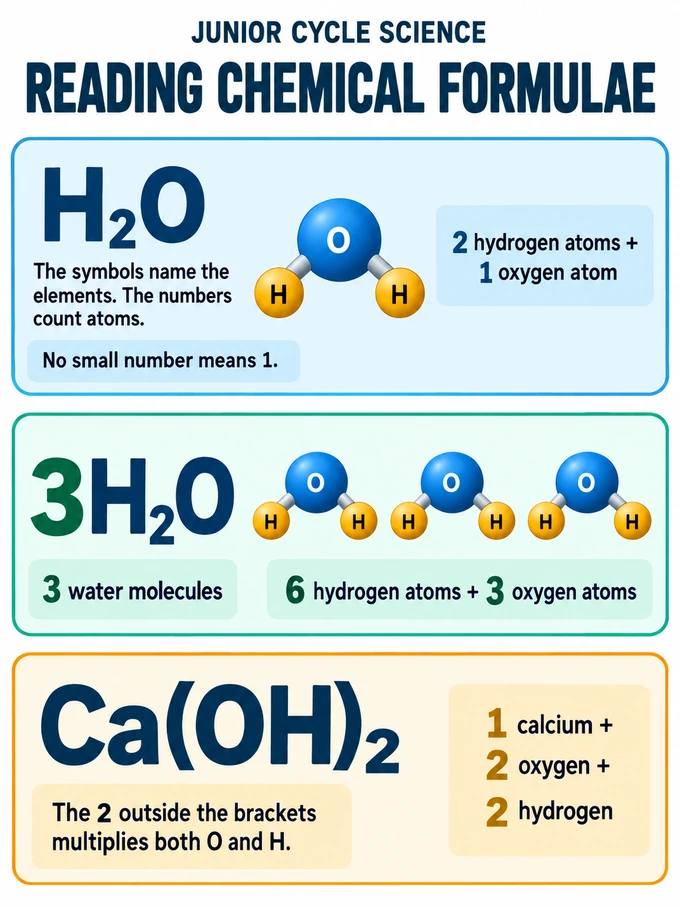
A chemical formula uses symbols to show which elements are present.
- A subscript is the small number after a symbol. It tells you how many atoms of that element are represented.
- No subscript means one.
| Formula | How to read it |
|---|---|
| H₂O | Each water molecule has 2 hydrogen atoms and 1 oxygen atom. |
| CO₂ | Each carbon dioxide molecule has 1 carbon atom and 2 oxygen atoms. |
| O₂ | Each oxygen molecule has 2 oxygen atoms. |
A number in front of a formula
A coefficient is the large number before a formula. It multiplies everything in the formula.
- 3H₂O means three water molecules.
- Hydrogen atoms: 3 × 2 = 6.
- Oxygen atoms: 3 × 1 = 3.
- The molecules are still water: the formula H₂O has not changed.
What do brackets mean?
A small number outside brackets applies to everything inside the brackets.
- Ca(OH)₂ contains two OH groups: 1 calcium, 2 oxygen and 2 hydrogen atoms per formula unit.
- 3Ca(OH)₂ multiplies every count by 3: 3 calcium, 6 oxygen and 6 hydrogen.
Ions and simple compound formulae
An ion is an atom or group of atoms with an electrical charge.
- Losing electrons makes an atom positive. Gaining electrons makes it negative.
- In simple ionic compounds: group 1 metals form +1 ions; group 2 metals form +2 ions; group 17 forms −1 ions; group 16 forms −2 ions.
- An ionic compound has no overall charge: positive and negative charges balance.
- Na⁺ and Cl⁻ balance in a 1:1 ratio, giving NaCl.
- One Mg²⁺ needs two Cl⁻ ions, giving MgCl₂. Ionic formulae show the simplest ratio of ions.
| Ions | Ratio needed | Formula |
|---|---|---|
| Na⁺ and Cl⁻ | 1 sodium : 1 chloride | NaCl |
| Mg²⁺ and Cl⁻ | 1 magnesium : 2 chloride | MgCl₂ |
| Na⁺ and O²⁻ | 2 sodium : 1 oxide | Na₂O |
| Mg²⁺ and O²⁻ | 1 magnesium : 1 oxide | MgO |
Atomic number and mass number
Atomic number and mass number tell you different things about an atom.
- Atomic number counts protons. Mass number counts protons + neutrons.
- Example: 8 protons and 10 neutrons give atomic number 8 and mass number 18. The atom is oxygen.
- Isotopes are atoms of the same element with different numbers of neutrons.
- Relative atomic mass on a periodic table is an average for the isotopes. It can be a decimal.
03Worked examples
How many calcium, oxygen and hydrogen atoms are represented by 3Ca(OH)₂?
Work through it
- Start with Ca(OH)₂. Ca has no subscript, so it represents 1 calcium atom.
- The 2 outside the brackets means 2 oxygen atoms and 2 hydrogen atoms.
- The 3 in front multiplies all three counts: calcium = 3, oxygen = 6, hydrogen = 6.
Another example
- To find the formula of magnesium chloride, use Mg²⁺ and Cl⁻.
- One Mg²⁺ has charge +2. Two Cl⁻ ions have total charge −2.
- The charges balance in a 1:2 ratio, so write MgCl₂.
04Common mistakes
Common mistake
“A group is a horizontal row.”
Remember: A group is a vertical column; a period is a horizontal row.
Common mistake
“3H₂O contains only two hydrogen atoms.”
Remember: The coefficient multiplies the whole formula: 3H₂O contains 6 hydrogen atoms and 3 oxygen atoms.
05Answering questions
- When counting atoms, apply bracket subscripts first, then multiply every count by the coefficient.
- For a simple ionic formula, write the ion charges and choose the smallest whole-number ratio that balances them.
06Infographic & reference diagrams
07Try an investigation
Find sodium, magnesium and chlorine on a periodic table. Record each symbol, atomic number, group and period. Use coloured counters to represent atoms, then build the examples H₂O, CO₂ and 3H₂O.
Do practical work with your teacher and follow the laboratory safety instructions.