By the end of this topic
- Name and explain the main processes in the water cycle.
- Trace carbon through photosynthesis, feeding, respiration and burning.
- Explain the difference between a store and a transfer.
01Key terms & definitions
- Evaporation
- Liquid water changing into water vapour at its surface.
- Condensation
- Water vapour changing into liquid water.
- Precipitation
- Water falling from clouds as rain, snow or hail.
- Transpiration
- The loss of water vapour from a plant, mainly through tiny pores in its leaves.
- Carbon store
- A place where carbon is held, such as the atmosphere, an ocean, a forest or rocks.
- Carbon transfer
- Carbon moving from one store to another, for example through feeding, respiration or burning.
02Understand the idea
Water moves around Earth
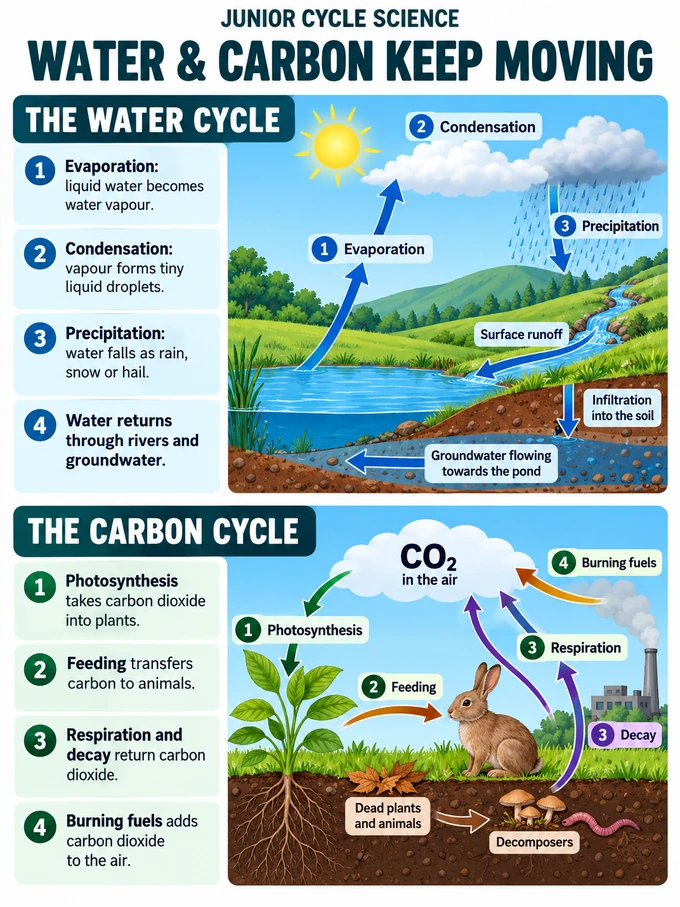
The water cycle describes water moving between the air, land and oceans.
- The same water can be used again and again.
- Water may stay briefly in one place or remain in ice or underground for many years.
From water to clouds and rain
Energy from the Sun drives evaporation; gravity brings precipitation to the ground.
- Evaporation: liquid water changes into water vapour, an invisible gas.
- Condensation: as moist air cools, water vapour changes into tiny liquid droplets.
- Clouds contain water droplets, ice crystals or both.
- Precipitation: water falls from clouds as rain, snow or hail.
Water on and under the ground
Water can follow several routes after reaching the ground.
- Surface runoff: water flows over the ground into streams and rivers.
- Infiltration: water soaks into the soil.
- Groundwater: water held in spaces and cracks underground.
- Plants take up water through their roots.
- Transpiration: water vapour leaves mainly through tiny leaf pores called stomata.
Where carbon is found
Carbon is an element found in all living things.
- Carbon stores include the atmosphere, oceans, living things, fossil fuels and rocks.
- The carbon cycle describes carbon moving between these stores.
- Some transfers are quick, such as an animal eating a leaf.
- Other changes, such as fossil-fuel formation, take millions of years.
Carbon moves through living things
| Process | What happens to carbon |
|---|---|
| Photosynthesis | Plants take in carbon dioxide and use its carbon to make glucose. |
| Feeding | Carbon in food moves from one organism to another. |
| Respiration | Living cells release energy from food and return carbon dioxide to the surroundings. |
| Decomposition | Decomposers break down dead organisms and waste. Carbon passes into decomposers and soil, and some returns to the air as carbon dioxide. |
Burning fuels and changing the cycle
Combustion means burning.
- Complete burning of a carbon-containing fuel in oxygen produces carbon dioxide.
- Burning fossil fuels moves carbon from underground stores into the atmosphere.
- Cutting down forests leaves fewer trees to take in carbon dioxide by photosynthesis.
- Carbon in removed trees may return to the air when the wood burns or decays.
Matter is transferred, not created
Arrows in a cycle show possible routes, not one compulsory journey.
- A water molecule or carbon atom does not have to follow every arrow.
- A store grows when more material enters than leaves.
- Example: 100 units + 12 entering − 7 leaving = 105 units.
- The extra carbon came from another store; it was not created.
03Worked examples
When methane burns completely in oxygen, carbon dioxide and water form: CH₄ + 2O₂ → CO₂ + 2H₂O. Check that the number of each type of atom is the same on both sides.
Work through it
- Carbon: CH₄ contains 1 carbon atom; CO₂ contains 1 carbon atom.
- Hydrogen: CH₄ contains 4 hydrogen atoms; 2H₂O contains 4 hydrogen atoms.
- Oxygen: 2O₂ contains 4 oxygen atoms; CO₂ and 2H₂O contain 4 oxygen atoms in total.
- The atoms have been rearranged to form new substances. No atoms have been lost or created.
04Common mistakes
Common mistake
“A cloud is made only of water vapour.”
Remember: Water vapour is invisible. Clouds contain tiny liquid-water droplets, ice crystals or both.
Common mistake
“Plants get the carbon in their food from soil minerals.”
Remember: Plants take in carbon dioxide, mainly through their leaves. Photosynthesis uses that carbon to make glucose.
05Answering questions
- When tracing a cycle, name each process on the arrow and show its direction. For example: lake → evaporation → water vapour → condensation → cloud droplets.
- For a carbon-transfer question, say where the carbon starts, the process moving it and where it ends. Avoid saying only “carbon goes round the cycle”.
06Infographic & reference diagrams
07Try an investigation
Draw a water-cycle diagram with arrows labelled evaporation, condensation, precipitation, runoff and transpiration. In a teacher-supervised test, place a clear bag around some leaves and compare it with an empty bag kept in the same conditions. Explain where any droplets could have come from.
Do practical work with your teacher and follow the laboratory safety instructions.