By the end of this topic
- Explain conduction, convection and radiation.
- Distinguish temperature from heating.
- Use the law of reflection and describe refraction.
- Explain pitch, loudness and why sound needs a material to travel through.
01Key terms & definitions
- Temperature
- A measure of how hot or cold something is, usually given in degrees Celsius (°C).
- Heating
- Energy moving from a hotter object or region to a cooler one.
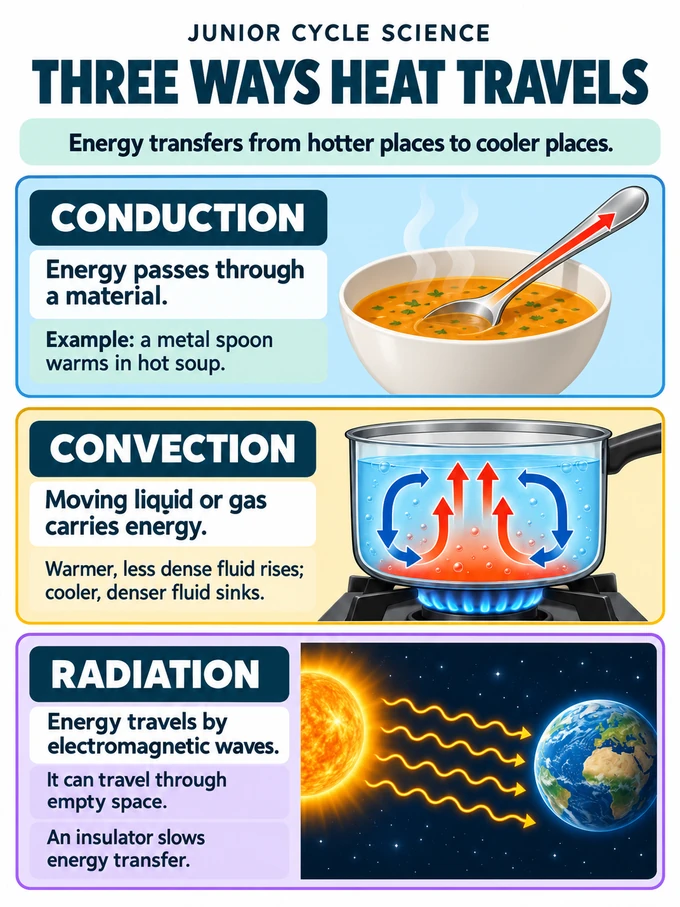
- Conduction
- Energy passing through a material without the material flowing from place to place.
- Convection
- Energy transfer by the movement of a liquid or gas.
- Radiation
- Energy transfer by electromagnetic waves. It can happen through empty space.
- Sound
- A vibration that travels through a material such as air, water or a solid.
02Understand the idea
Temperature and heating
Temperature tells us how hot or cold something is. Heating transfers energy from hotter to cooler places.
- Measure temperature with a thermometer, usually in degrees Celsius (°C).
- A hot drink cools as it transfers energy to its cooler surroundings.
- Temperature alone does not tell us how much energy an object can transfer.
- A bath of warm water can transfer more energy as it cools than a much hotter teaspoon of water, because it contains far more water.
Conduction
Conduction transfers energy through a material without the material moving from place to place.
- Particles at the hot end move more vigorously and pass energy to neighbouring particles.
- Example: the handle of a metal spoon warms when the other end is in hot soup.
- Metals conduct well. Wood and plastic conduct poorly and are thermal insulators.
- Metal feels colder than wood at the same room temperature because it carries energy away from your hand faster.
Convection
Convection transfers energy by the movement of a liquid or gas.
- Heating usually makes water expand and become less dense.
- Warmer, less dense water rises; cooler, denser water moves down to replace it.
- This circulation is a convection current. It spreads energy through a saucepan of water or air near a heater.
- Convection cannot happen in a solid because the material cannot flow.
Radiation and insulation
Radiation transfers energy by electromagnetic waves. An insulator slows energy transfer.
- Radiation can cross empty space: energy from the Sun reaches Earth this way.
- A coat traps air, which conducts poorly, and stops it circulating freely.
- A shiny surface can reduce heat transfer by radiation.
- Insulation does not produce heat. A sleeve slows the cooling of a hot cup.
- Compare insulation using identical cups, equal water volumes and the same starting temperatures and timing.
Light and reflection
Light travels in straight lines through a uniform material. Reflection is light bouncing off a surface.
- Light can travel through a vacuum: space containing no matter.
- Draw the normal at right angles to the surface where the ray hits.
- Angle of incidence: between the incoming ray and the normal.
- Angle of reflection: between the reflected ray and the normal.
- Angle of incidence = angle of reflection.
Refraction
Refraction is the change in direction that can happen when light enters a different material and changes speed.
- Light entering glass or water at an angle usually bends.
- Refraction makes a straw in water appear bent at the surface.
- Light entering along the normal changes speed but does not change direction.
How sound travels
Sound starts with a vibrating object, such as a guitar string or loudspeaker cone.
- The source makes nearby particles vibrate. They pass the disturbance to neighbouring particles.
- The material carrying sound is called the medium: it can be a solid, liquid or gas.
- Sound cannot travel through a vacuum because there are no particles to pass on the vibration.
- Air particles move back and forth near their starting positions, not all the way from the source to your ear.
Pitch and loudness
Pitch and loudness describe different features of sound.
- Frequency: the number of vibrations each second, measured in hertz (Hz).
- Higher frequency means higher pitch. A 440 Hz sound is higher-pitched than a 220 Hz sound.
- Amplitude: the size of the vibration.
- For sounds of the same frequency, greater amplitude generally means greater loudness.
- A high-pitched sound can still be quiet.
03Worked examples
Two identical cups of water start at 60 °C. After 8 minutes, the uninsulated cup is at 48 °C and the insulated cup is at 54 °C. Compare their cooling.
Work through it
- Uninsulated cup: temperature drop = 60 − 48 = 12 °C.
- Insulated cup: temperature drop = 60 − 54 = 6 °C.
- The insulated cup cooled less. The insulation slowed energy transfer to the surroundings; it did not make heat.
Another example
- A light ray strikes a mirror at 30° to the normal.
- The angle of reflection is also 30° to the normal.
- The normal is 90° to the mirror, so each ray makes 90° − 30° = 60° with the mirror surface.
04Common mistakes
Common mistake
“Saying insulation makes heat.”
Remember: Insulation slows energy transfer from a warmer object to cooler surroundings.
Common mistake
“Measuring reflection angles from the mirror surface.”
Remember: Measure the incidence and reflection angles from the normal, which is at right angles to the mirror.
05Answering questions
- Explain a heat-transfer example by naming the method and describing how energy moves in that example.
- For sound comparisons, link frequency to pitch and amplitude to loudness; do not mix the two.
06Infographic & reference diagrams
07Try an investigation
Compare the cooling of equal volumes of warm water in identical cups with and without insulation. Measure the temperature at regular times and plot temperature against time. Use your teacher’s safe water temperature. For light and sound activities, avoid looking at the Sun or laser beams and keep sounds at comfortable levels.
Do practical work with your teacher and follow the laboratory safety instructions.