By the end of this topic
- Explain what a model shows and what it leaves out.
- Separate a claim from the evidence supporting it.
- Check sources and communicate a clear conclusion.
01Key terms & definitions
- Model
- A simplified representation used to explain or predict something.
- Evidence
- Observations or measurements that support or question an explanation.
- Source evaluation
- Checking where information comes from and whether its evidence is reliable.
- Peer review
- Other specialists checking a scientific report before it is published.
- Scientific theory
- A broad scientific explanation supported by a large amount of evidence.
- Uncertainty
- A limit to how exactly we can measure something or how confidently we can explain it.
02Understand the idea
What is a scientific model?
A model is a simplified way of showing or explaining something.
- It may be a drawing, a physical object or a computer simulation.
- Models help us study things that are too large, too small or difficult to examine directly.
- A globe and lamp can show how Earth’s rotation causes day and night.
- Their sizes and distance are not realistic, but they show which side of Earth is lit.
Claims and evidence
A claim says something is true. Evidence supports or questions that claim.
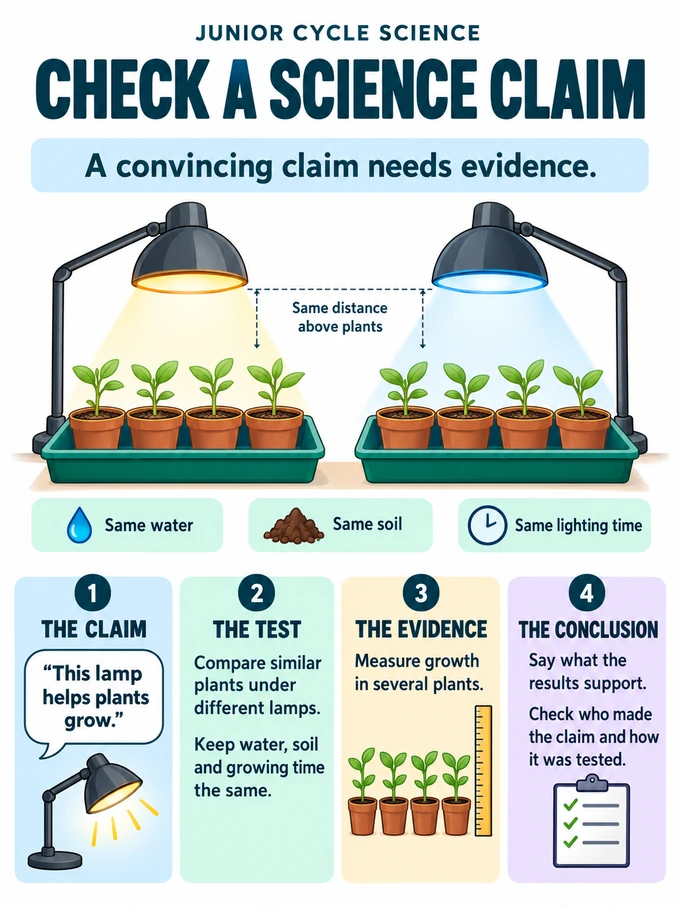
- Claim: “This new lamp helps plants grow.”
- Evidence needed: measurements of plant growth, not just a photograph.
- Compare similar plants under the new lamp and the usual lamp.
- Keep water, growing time and other important conditions the same.
Check the source
A source is where information comes from, such as a report, book or website.
- Who wrote it, and what experience do they have?
- What observations or measurements support it?
- Is the method clear, and is the information up to date?
- Is the author trying to sell something?
- Do separate, independent studies support the result?
How scientists check ideas
Scientists share methods and results so that others can check the work.
- Other researchers can question the method and repeat the investigation.
- Peer review: specialists examine a research report before publication. It helps find weaknesses, but mistakes can still be missed.
- Several websites repeating one report still use only one source.
- Separate studies with similar findings give stronger support.
Models can improve
New evidence can help scientists improve or replace a model.
- A scientific theory is a broad explanation supported by a large amount of evidence, such as the theory of evolution.
- In science, a theory is not an unsupported guess.
- Uncertainty is a limit to what we know or can measure.
- A ruler may measure to the nearest millimetre, but not to a millionth of a millimetre.
Communicate clearly
Make your reasoning easy for another person to follow.
- State the question, method, results and conclusion.
- Use labelled diagrams and units for measurements.
- Record enough source information for someone else to find it.
- Explain the evidence and the contributions of scientists, engineers, technicians and other researchers.
- When discussing a technology, include benefits and possible drawbacks.
03Worked examples
A study compares two groups of the same plant species for one week. Mean growth is 4 cm under a new lamp and 2 cm under the usual lamp. A headline says, “New lamp doubles plant growth.”
Work through it
- Compare the means: 4 cm is twice 2 cm.
- Write what was tested: this plant species, these lamps and one week.
- A suitable conclusion is: “In this study, the plants under the new lamp grew twice as much on average.” More tests are needed before making the same claim for all plants.
04Common mistakes
Common mistake
“A scientific theory is just a guess.”
Remember: A scientific theory is a broad explanation supported by a large amount of evidence.
Common mistake
“Three websites reporting a study count as three independent studies.”
Remember: They may all repeat the same original report. Trace the source to find out whether the evidence is independent.
05Answering questions
- For a model question, state what each part represents, what it helps explain and one detail it does not show accurately.
- When evaluating a claim, name the supporting evidence and explain whether the method was a fair test. Separate what was observed from what was concluded.
06Infographic & reference diagrams
07Try an investigation
Choose a science claim with your teacher. Compare two sources, record where their evidence comes from and explain which source gives stronger support. Present your conclusion with one labelled diagram or small results table.
Do practical work with your teacher and follow the laboratory safety instructions.