By the end of this topic
- Describe useful and harmful roles of microbes.
- Distinguish bacteria from viruses.
- Describe some of the body’s defences.
- Explain why one person’s experience is not enough to prove a health claim.
01Key terms & definitions
- Health
- Physical, mental and social wellbeing.
- Pathogen
- An organism or infectious agent that causes disease.
- Microorganism
- A living organism too small to see clearly without a microscope.
- Immune response
- The body’s defence against pathogens and other harmful material.
- Risk factor
- Something that changes the chance of a health outcome.
- Reliable health evidence
- Health information supported by trustworthy sources and well-conducted investigations.
02Understand the idea
What is health?
Health includes physical, mental and social wellbeing. It is influenced by many things, including inherited characteristics, diet, activity, living conditions, infection and access to healthcare.
A single habit does not explain every illness. People with similar habits or inherited risks can have different health outcomes.
Microorganisms are not all harmful
Microorganisms are living things too small to see clearly without a microscope. Many bacteria and fungi are harmless or useful.
- Some bacteria help with digestion.
- Microbes are used in food production.
- Decomposers break down dead material and return nutrients to the environment.
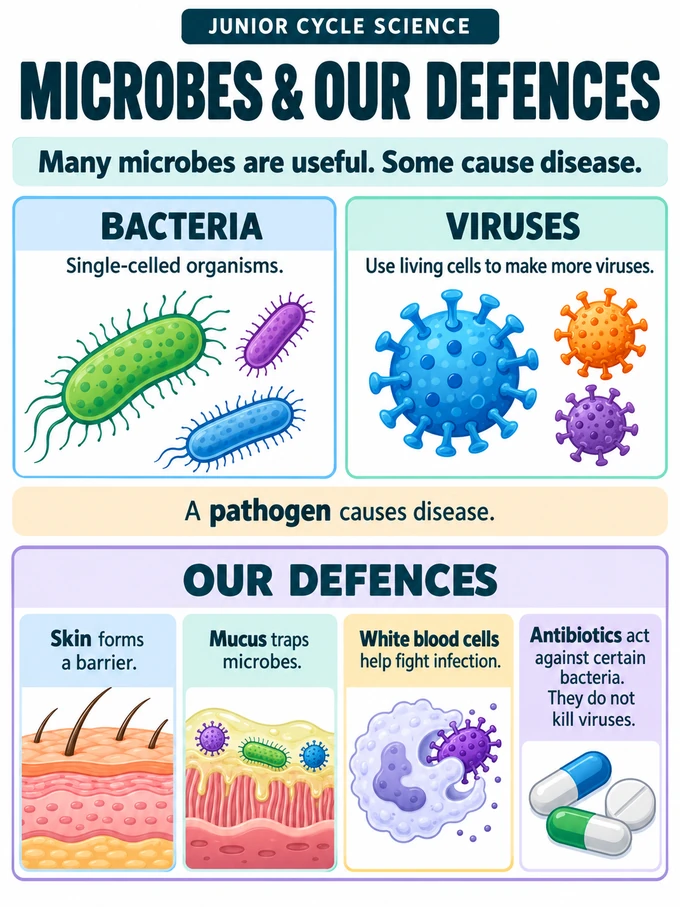
- A pathogen causes disease. Some bacteria, fungi and viruses are pathogens, but not all microbes cause disease.
Bacteria and viruses
Bacteria and viruses have different structures and reproduce in different ways.
- Bacteria are single-celled organisms.
- Viruses are much smaller and use living cells to make more viruses.
- Antibiotics act against certain bacteria. They do not kill viruses, so they do not treat the virus itself in a viral infection.
The body’s defences
The body has barriers that help keep pathogens out. If pathogens enter, the immune system responds.
- Skin forms a physical barrier.
- Mucus traps microbes.
- Stomach acid kills many swallowed microbes.
- Some white blood cells engulf pathogens.
- Other white blood cells help make antibodies, which recognise particular targets on pathogens.
What does a risk factor mean?
A risk factor changes the chance of an outcome. It does not tell us for certain what will happen to one person. For example, a factor linked to a greater chance of disease does not mean that everyone with that factor will develop the disease.
Scientists compare groups to investigate risks. They also consider other differences between the groups, such as age, that could affect the result.
Checking a health claim
Suppose someone says, “I took this product and felt better, so it cured me.” That is one person’s experience. The person might have recovered naturally or changed something else at the same time.
A fair comparison provides stronger evidence. Ask what was measured, how many people were included and whether the groups were similar before the comparison. A headline or advertisement is not the same as the full evidence.
- Who made the claim, and are they selling something?
- What evidence supports it?
- Was there a fair comparison?
- Could another factor explain the result?
- Does a reliable health organisation support the information?
03Worked examples
An advertisement says that a drink improved people’s energy. However, the group drinking it was much younger than the comparison group. Age could explain some of the difference.
Work through it
- Identify the claim: the drink caused the improvement.
- Check whether the groups were similar before the test.
- Notice the age difference, which could affect the result.
- Conclude that this comparison alone cannot show that the drink caused the improvement.
04Common mistakes
Common mistake
“All microbes cause disease.”
Remember: Many are harmless or useful, including microbes involved in digestion, food production and decomposition.
Common mistake
“Antibiotics kill viruses.”
Remember: Antibiotics act against certain bacteria. Viruses have different structures and use living cells to reproduce.
05Answering questions
- When evaluating a claim, identify the comparison and consider another possible explanation for the result.
- Use “increases the chance” when discussing a risk factor. Explain why it does not predict what must happen to one person.
06Infographic & reference diagrams
07Try an investigation
Compare two fictional health advertisements with a supplied evidence summary. Identify the claim, the evidence and any missing information. Use approved school procedures for any microbiology work.
Do practical work with your teacher and follow the laboratory safety instructions.