By the end of this topic
- Distinguish a star, planet, moon, asteroid and comet.
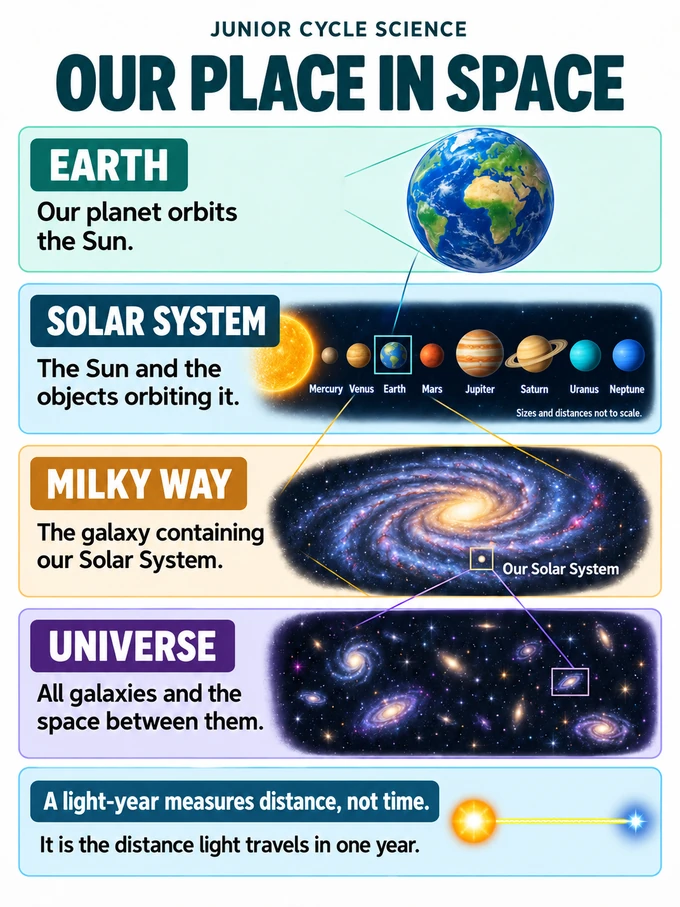
- Place the Solar System within the Milky Way.
- Explain a light-year and describe evidence for the Big Bang model.
01Key terms & definitions
- Solar System
- The Sun and the planets, moons, asteroids, comets and other objects that orbit it.
- Star
- A huge ball of hot gas that gives out its own light and heat.
- Galaxy
- A very large group of stars, gas, dust and other matter held together by gravity.
- Light-year
- The distance light travels in one year.
- Big Bang model
- The explanation that the Universe expanded and cooled from an early hot, dense state.
- Evidence
- Observations or measurements that support or question an explanation.
02Understand the idea
Our place in the Universe
Gravity keeps objects such as planets and moons in their orbits.
- The Moon orbits Earth. Earth orbits the Sun.
- The Solar System contains the Sun and the objects orbiting it.
- The Sun is one star in the Milky Way galaxy.
- The Universe includes all galaxies and the space between them.
Stars, planets and moons
Stars, planets and moons are different kinds of object.
- Star: gives out its own light and heat. The Sun is our nearest star.
- In the Sun’s core, nuclear fusion joins small atomic nuclei and releases energy.
- Planet: orbits a star and is seen by reflected starlight.
- Moon: a natural object orbiting a planet or another larger body. Some planets have many moons.
Asteroids and comets
Asteroids and comets also orbit the Sun.
- Asteroids are small rocky or metallic bodies. Many lie between Mars and Jupiter.
- Comets contain ice, dust and rocky material.
- Near the Sun, some comet ice changes to gas. Released gas and dust can form tails.
- Tails point generally away from the Sun because of sunlight and particles flowing from the Sun.
Distances in space
A light-year is the distance light travels in one year.
- It measures distance, not time.
- It is useful because distances in space are enormous.
- If a star is 20 light-years away, its light takes about 20 years to reach us.
- We see that star as it was about 20 years ago.
The Big Bang model
The Big Bang model describes how the Universe expanded and cooled from an early hot, dense state.
- The Universe was once much hotter and denser than it is today.
- Space itself expanded; this was not an ordinary explosion into empty space.
- Scientists compare the model’s predictions with observations. Several different observations support it.
Evidence for the Big Bang
| Observation | How it supports the model |
|---|---|
| Most distant galaxies show redshift: their light is stretched towards longer wavelengths. | This fits an expanding Universe, in which distant galaxies move farther apart overall. |
| A faint microwave signal reaches us from all directions. | This cosmic microwave background is radiation left from the early hot Universe, now cooled as space expanded. |
| The Universe contains large amounts of hydrogen and helium. | Their amounts broadly match predictions about the early Universe. |
Changing ideas about space
New observations can change scientific models.
- An early model placed Earth at the centre.
- Copernicus proposed a model with planets orbiting the Sun.
- Galileo later observed moons orbiting Jupiter. This showed that not everything orbited Earth.
- Improved telescopes and other instruments allow more detailed tests.
03Worked examples
Light from the Sun takes about 8 minutes to reach Earth. What does this tell us about the sunlight we receive?
Work through it
- Light leaves the Sun and travels through space.
- It reaches Earth about 8 minutes later.
- The sunlight reaching us now gives us information about the Sun as it was about 8 minutes ago.
Another example
- An icy body orbits the Sun and releases gas and dust near it. These features identify it as a comet.
- Its tail points generally away from the Sun. It is not simply a trail left behind along its path.
04Common mistakes
Common mistake
“A light-year is a length of time.”
Remember: It is a distance: how far light travels in one year.
Common mistake
“The Solar System and the Milky Way are the same thing.”
Remember: The Solar System contains our Sun and its orbiting objects. It is a tiny part of the Milky Way galaxy.
05Answering questions
- For a scale question, place Earth inside the Solar System, and the Solar System inside the Milky Way. State the relationship as well as the order.
- When giving evidence for the Big Bang model, name an observation and explain the link: for example, galaxy redshifts support an expanding Universe.
06Infographic & reference diagrams
07Try an investigation
Make a diagram showing the Moon, Earth, Solar System, Milky Way and Universe. Label what lies inside what. Compare two observations that support the Big Bang model. Never look directly at the Sun or view it through ordinary binoculars or a telescope.
Do practical work with your teacher and follow the laboratory safety instructions.