By the end of this topic
- Explain how DNA, chromosomes and genes are connected.
- Distinguish inherited and environmental differences.
- Compare sexual and asexual reproduction.
- Use a simple allele example to predict possible offspring.
01Key terms & definitions
- DNA
- The molecule that carries genetic information.
- Gene
- A section of DNA that helps determine a characteristic or controls a cell process.
- Chromosome
- A structure made of DNA that carries many genes.
- Sexual reproduction
- Reproduction in which two gametes join.
- Asexual reproduction
- Reproduction from one parent without gametes joining.
- Variation
- Differences between individuals of the same species.
02Understand the idea
Why do offspring resemble their parents?
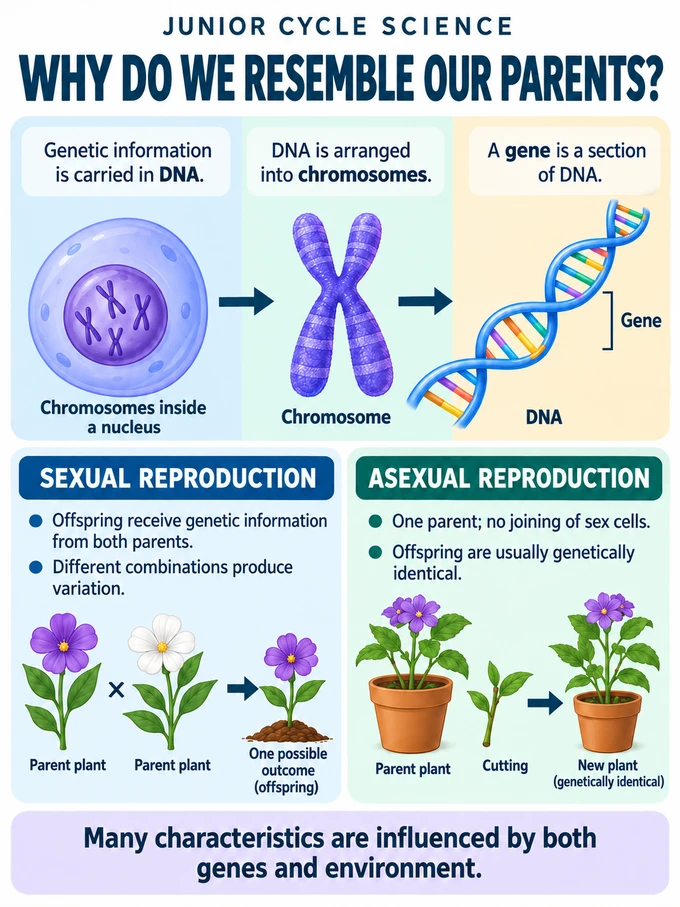
Offspring inherit genetic information from their parents. This helps explain why related organisms often resemble one another.
- DNA is the molecule that carries genetic information.
- Chromosomes are structures made of DNA. Each carries many genes.
- A gene is a section of DNA that helps determine a characteristic or controls a cell process.
Variation: why individuals differ
Variation means differences between individuals of the same species.
- Inherited differences come from genetic information passed on by parents.
- Environmental differences result from growing conditions, such as the light a plant receives.
- Many characteristics involve both. Human height depends on many genes and factors such as nutrition.
Sexual reproduction
Sexual reproduction involves two sex cells, called gametes. In humans, these are sperm and egg cells. Their nuclei join at fertilisation. The offspring receives genetic information from both parents.
Different combinations of genetic information mean that offspring usually differ from their parents and from one another.
Asexual reproduction
Asexual reproduction involves one parent and no joining of gametes. A plant cutting can grow into a new plant this way.
- Offspring are usually genetically identical to the parent.
- A mutation, which is a change in DNA, can sometimes create a difference.
- Asexual reproduction can produce many offspring quickly.
- Sexual reproduction produces more genetic variation, which can help a population survive environmental change.
Alleles: different versions of a gene
An allele is a version of a gene. In the simple example below, each plant has two alleles for flower colour: one from each parent.
We use A for a purple-flower allele and a for a white-flower allele. In this example, A is dominant: a plant with Aa has purple flowers. The recessive white-flower characteristic appears only when both alleles are a.
| Alleles | Flower colour |
|---|---|
| AA | Purple |
| Aa | Purple |
| aa | White |
Predicting an inheritance pattern
Cross two plants with Aa alleles. Each parent can pass on either A or a. This is a simple one-gene example; many real characteristics are more complicated.
- The four equally likely combinations are AA, Aa, aA and aa. Aa and aA are the same combination.
- Three combinations give purple flowers: each offspring has a 3 in 4 chance of being purple.
- One combination gives white flowers: each offspring has a 1 in 4 chance of being white.
- Four actual offspring need not contain exactly three purple plants and one white plant.
- Dominant does not mean stronger, better or more common.
Genes and growing conditions
Two cuttings from the same plant may have the same genes but grow to different heights if they receive different amounts of light. The growing conditions can affect the result without changing the inherited DNA.
To investigate this, use several similar cuttings and change only the light level. Keep water, soil and temperature as similar as possible.
03Worked examples
Two similar plant cuttings grow by different amounts when given different light levels. If other conditions were kept the same, this supports the idea that light affected their growth.
Work through it
- Start with similar cuttings from the same plant.
- Give the groups different light levels but keep water, soil and temperature the same.
- Measure growth over the same period and compare several plants in each group.
Another example
- For the flower-colour example, cross Aa with aa.
- The first parent can pass on A or a. The second can pass on only a.
- The possible offspring are Aa (purple) and aa (white), each with a 1 in 2 chance.
04Common mistakes
Common mistake
“A dominant allele is stronger or more common.”
Remember: Dominant describes its effect when paired with a different allele. It does not tell us how common it is.
Common mistake
“A 3:1 ratio means four offspring must be three purple and one white.”
Remember: The ratio describes probabilities. A small group of offspring may have a different result.
05Answering questions
- For an inheritance cross, list the alleles each parent can pass on before combining them.
- When explaining variation, say whether the example involves genes, environment or both, and name the factor involved.
06Infographic & reference diagrams
07Try an investigation
Compare plants grown from seeds with plants grown from cuttings. Use supplied plant data to explore inheritance and growing conditions.
Do practical work with your teacher and follow the laboratory safety instructions.