By the end of this topic
- Distinguish living and non-living factors in a habitat.
- Explain how to use quadrats and transects.
- Calculate a mean count and estimate abundance.
- Explain an adaptation in relation to an organism’s habitat.
01Key terms & definitions
- Habitat
- The place where an organism lives.
- Community
- The populations of different species living in the same area.
- Abiotic factor
- A non-living factor in the environment, such as light or temperature.
- Biotic factor
- An effect of living organisms, such as competition or predation.
- Quadrat
- A frame used to mark a sample area in a habitat.
- Competition
- The struggle for a limited resource needed by more than one organism.
02Understand the idea
What is a habitat?
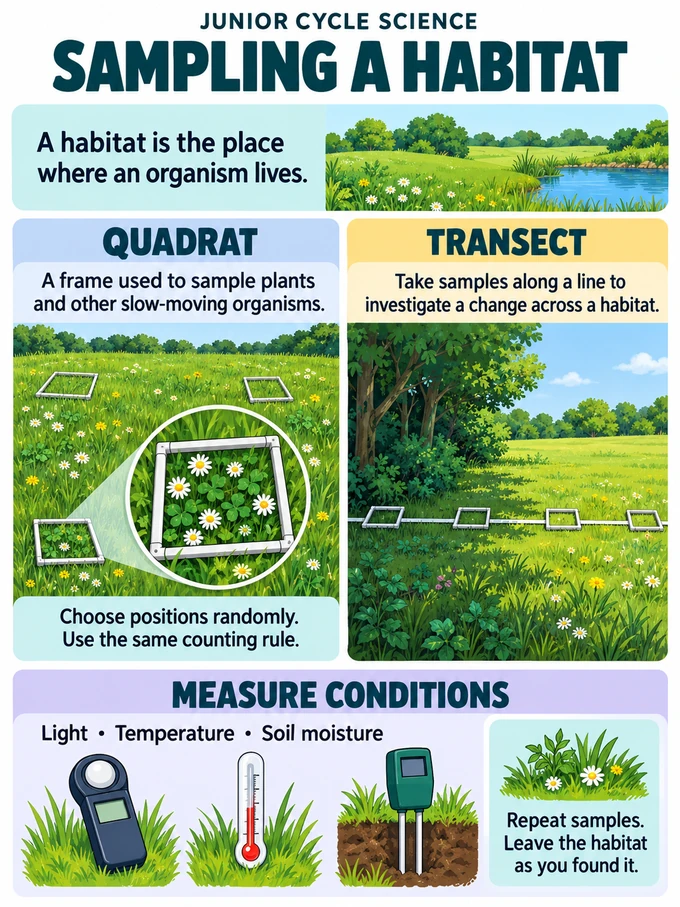
A habitat is the place where an organism lives, such as a pond, woodland or rock pool. Its conditions suit some organisms better than others.
- Population: all the organisms of one species in an area.
- Community: the different populations living together in an area.
What affects organisms in a habitat?
Abiotic factors are the non-living parts of the environment. Examples include light, temperature, soil moisture and pH. Biotic factors are effects caused by other living things.
| Factor | Example |
|---|---|
| Light | A shaded area may have different plants from an open area. |
| Moisture | Some plants grow best in wet soil. |
| Competition | Plants compete for limited light, water and minerals. |
| Predation | A bird eats insects. |
Sampling with a quadrat
A quadrat is a frame enclosing a measured area. It samples plants and other organisms that do not move around much. Small samples help estimate abundance across a whole habitat.
- Choose positions randomly when estimating the whole area, so you do not select only crowded or empty patches.
- Use several quadrats and keep the counting rule the same.
- Agree how to count a plant touching the frame.
- Choose a suitable measure: number of plants, how often a species occurs, or percentage cover.
Using a transect
A transect is a line placed across a habitat, for example from woodland shade into an open field.
- Take observations at set points along the line.
- Record the organisms and relevant conditions, such as light or soil moisture.
- Compare the samples to see how organisms change as conditions change.
Adaptations and competition
An adaptation is an inherited feature that helps an organism survive and reproduce in its environment. For example, a cactus has features that reduce water loss in dry conditions. Such features became common over generations; a plant does not grow them simply because it decides it needs them.
Competition happens when organisms need the same limited resource. Plants of the same species or different species may compete for light, water, space and minerals.
Making an estimate
Use repeated samples to estimate abundance.
- Add the counts and divide by the number of quadrats to find the mean count.
- Use the quadrat’s area to convert the mean to an estimate per square metre.
- Keep the individual counts: different quadrats usually contain different numbers.
- The estimate is most useful when the sample positions fairly represent the habitat.
Explaining a pattern
If a plant is more common in damp places, moisture may help explain the pattern. Other factors, such as shade or soil type, may also differ. Further investigation is needed to separate these effects.
During fieldwork, follow the planned route, minimise disturbance and leave organisms and habitats as you found them.
03Worked examples
Four quadrats, each 0.25 m², contain 2, 4, 3 and 3 daisies. The estimated density is 12 daisies per square metre.
Work through it
- Add the counts: 2 + 4 + 3 + 3 = 12.
- Find the mean: 12 ÷ 4 = 3 daisies per quadrat.
- Each quadrat covers one quarter of a square metre.
- Multiply by 4: 3 × 4 = 12 daisies per m².
04Common mistakes
Common mistake
“Choosing the patches with the most plants gives the best estimate.”
Remember: That is likely to overestimate abundance. Random positions give a fairer sample of the whole area.
Common mistake
“A mean of 3 plants per quadrat always means 3 plants per square metre.”
Remember: You must use the quadrat’s area to convert the count into a density per square metre.
05Answering questions
- Describe where and how samples are taken, how many are used and what will be counted or measured.
- When explaining a habitat pattern, name another factor that could also affect the organisms, such as moisture as well as shade.
06Infographic & reference diagrams
07Try an investigation
Carry out a teacher-planned habitat study. Use repeated quadrats or a transect, record the sampling positions and keep the counting rule consistent. Measure relevant environmental factors and wash your hands after fieldwork.
Do practical work with your teacher and follow the laboratory safety instructions.