By the end of this topic
- Explain solute, solvent, solution and saturation.
- Choose a separation method for a mixture.
- Distinguish dissolving faster from dissolving more.
01Key terms & definitions
- Solute
- The substance that dissolves in a solvent.
- Solvent
- The liquid in which a solute dissolves.
- Solution
- A mixture formed when a solute dissolves in a solvent.
- Saturated solution
- A solution in which no more solute will dissolve at that temperature.
- Filtration
- Separating an insoluble solid from a liquid using a filter.
- Distillation
- Separating and collecting a liquid by boiling it and then cooling its vapour.
02Understand the idea
What happens when something dissolves?
When sugar dissolves, its particles spread among the water particles. The sugar is still present in the solution.
- Solute: the substance that dissolves, such as sugar.
- Solvent: the liquid it dissolves in, such as water.
- Dissolving is different from melting. Melting is a change from solid to liquid caused by heating.
Concentration and saturation
Concentration tells us how much solute is dissolved in a given amount of solution.
- More dissolved solute in the same volume means a higher concentration.
- A saturated solution cannot dissolve any more solute at that temperature. Extra solid remains undissolved.
- Solubility is the maximum amount that dissolves in a given amount of solvent at a stated temperature.
Dissolving faster or dissolving more?
Speed of dissolving and solubility are different.
- Stirring brings fresh solvent into contact with the solid, helping it dissolve faster.
- Crushing exposes more surface and helps a solid dissolve faster.
- Heating often speeds up dissolving and can increase the amount of solid that dissolves.
- Many solids are more soluble in warm water. Gases generally become less soluble as water warms.
Filtration: removing an insoluble solid
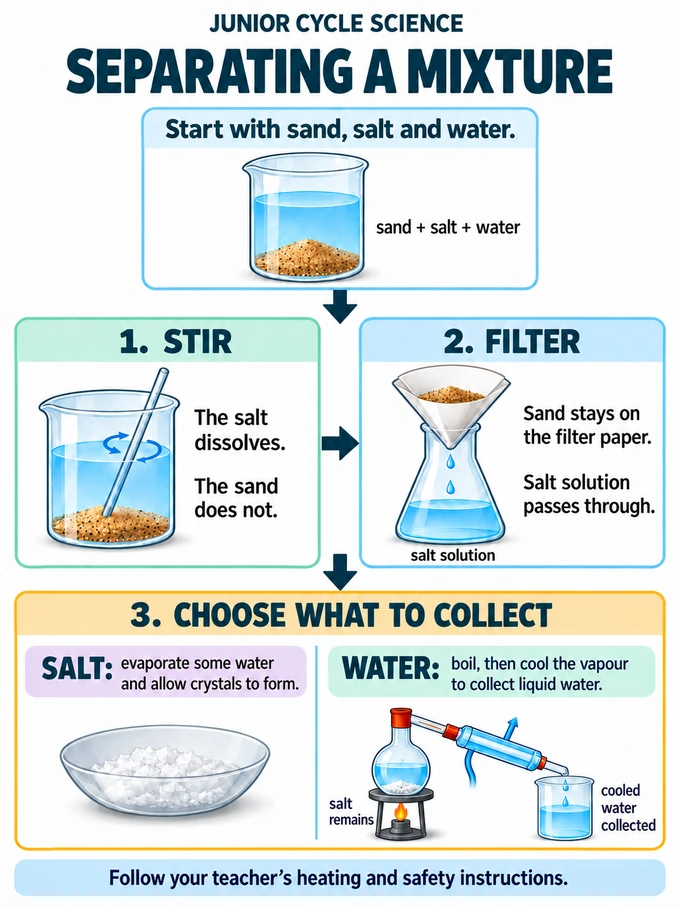
Filtration separates an insoluble solid from a liquid, such as sand from water.
- Pour the mixture through filter paper in a funnel.
- Residue: the solid left in the filter paper.
- Filtrate: the liquid that passes through.
- Dissolved salt passes through with water. Ordinary filtration cannot separate salt from salt water.
Evaporation and crystallisation: recovering a solid
Evaporation and crystallisation recover a dissolved solid.
- Evaporating some water from salt water makes the solution more concentrated.
- Salt crystals can form as more water evaporates.
- Many substances also form crystals when a hot, concentrated solution cools and less solute can stay dissolved.
- Use your teacher’s heating method. Heating to complete dryness can cause spitting.
Distillation: collecting the water
Distillation separates and collects a liquid by boiling it and then cooling its vapour.
- Heat salt water: water evaporates and salt stays behind.
- The vapour enters a condenser, cools and becomes liquid water.
- Distillate: the liquid collected.
- Want the salt? Use evaporation or crystallisation. Want to collect the water? Use distillation.
Chromatography: separating colours
Paper chromatography separates substances in a mixture because they travel different distances with a solvent.
- Draw a pencil line near the bottom of the paper and add a small ink spot.
- Stand the paper in solvent, keeping the spot above the solvent level.
- As the solvent rises, it carries the colours with it.
- Colours separate because they dissolve in the solvent and stick to the paper to different extents.
- Use pencil so the starting line does not dissolve and spread.
03Worked examples
A mixture contains sand, salt and water. How could you recover the sand and some salt crystals?
Work through it
- Stir so that the salt dissolves in the water. The sand stays insoluble.
- Filter the mixture. The sand stays in the filter paper; salt solution passes through.
- Use the teacher’s method to evaporate some water from the salt solution. Allow crystals to form, then collect and dry them.
Another example
- A salt solution contains 12 g of salt in 200 cm³ of solution.
- Mass concentration = mass of solute ÷ volume of solution = 12200 = 0.060 g/cm³.
- This is also 60 g per litre. Use the volume of the final solution in the calculation.
04Common mistakes
Common mistake
“Filter paper removes dissolved salt from water.”
Remember: Dissolved salt passes through with the water. Use evaporation to recover salt or distillation to collect water.
Common mistake
“Stirring increases the maximum amount that can dissolve.”
Remember: Stirring speeds up dissolving. Solubility is the maximum amount that dissolves at a stated temperature.
05Answering questions
- Choose a separation method by naming the property it uses, such as solubility or boiling point, and say which substance you want to collect.
- For chromatography, explain both choices: pencil does not dissolve and spread; keeping the spot above the solvent prevents it washing straight into the solvent.
06Infographic & reference diagrams
07Try an investigation
Separate a mixture of sand, salt and water using filtration and crystallisation. Follow the teacher’s instructions for heating, eye protection and handling hot equipment.
Do practical work with your teacher and follow the laboratory safety instructions.