By the end of this topic
- Identify common energy stores and transfers.
- Explain why energy is conserved when an object stops moving.
- Calculate efficiency.
01Key terms & definitions
- Energy
- The ability to bring about changes such as movement or heating. Measured in joules (J).
- Kinetic energy
- Energy an object has because it is moving.
- Gravitational energy
- Energy stored when an object is raised in a gravitational field.
- Transfer
- Energy moving from one place to another, such as from a battery to a lamp.
- Dissipation
- Energy spreading into the surroundings, usually by heating, so it is harder to use again.
- Efficiency
- The fraction of input energy that becomes useful output, usually given as a percentage.
02Understand the idea
Energy makes changes possible
Energy is needed for changes such as movement, heating and lighting. It is measured in joules (J).
- Kinetic energy: stored in a moving object.
- Chemical energy: stored in food, fuels and batteries.
- Gravitational potential energy: stored when an object is raised above the ground.
Energy can be transferred
Energy can move from one place to another.
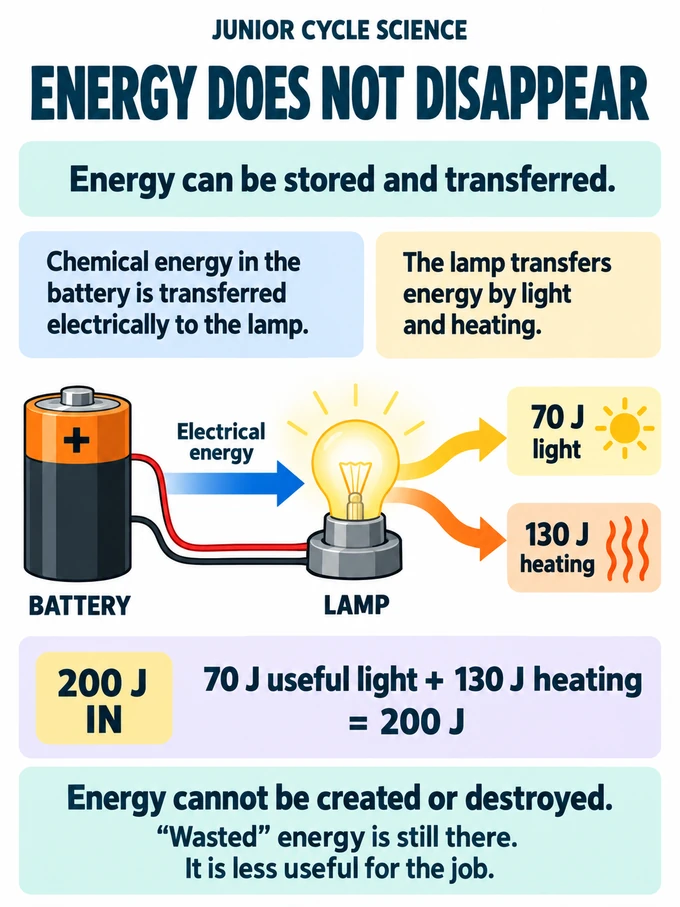
- A battery transfers energy electrically to a lamp.
- The lamp transfers energy to its surroundings by light and heating.
- Energy can also be transferred by sound or when a force moves an object.
- Pushing a trolley transfers energy from you to the trolley.
Following a falling ball
Follow the energy as a ball falls and bounces.
- Lift the ball: its gravitational potential energy increases.
- Release it: gravitational potential energy decreases as kinetic energy increases.
- At impact, the ball and floor change shape and warm slightly; some energy travels away as sound.
- If the ball bounces, some energy becomes kinetic energy again.
Energy is conserved
Energy cannot be created or destroyed. This is the law of conservation of energy.
- Energy can be transferred or changed from one form to another.
- When a ball stops bouncing, its energy has spread to the ball, floor and surrounding air.
- Include the object and its surroundings when accounting for all the energy.
Useful and wasted energy
Useful energy helps a device do its job. “Wasted” energy does not help with that job.
- For a lamp, light is useful; heating the room may be unwanted.
- For a heater, heating the room is the useful output.
- Wasted energy is not destroyed. It usually spreads into the surroundings and is harder to use again.
- This spreading out is called dissipation.
Efficiency
Efficiency tells us what fraction of the input energy becomes useful output.
- Percentage efficiency = (useful energy output ÷ total energy input) × 100.
- For 200 J input and 70 J useful output: efficiency = 70 ÷ 200 × 100 = 35%.
- The remaining 130 J is transferred in other ways, such as heating the surroundings.
Reading an energy-flow diagram
An energy-flow diagram uses arrows to show energy inputs and outputs.
- In a diagram drawn to scale, a wider arrow represents more energy.
- If the device is not storing more energy, all output amounts add up to the input.
- Some devices also store energy, such as a rechargeable battery while charging.
- Energy is an amount, measured in J. Power is how quickly energy is transferred, measured in W.
03Worked examples
A device receives 200 J of energy and transfers 70 J usefully. Find the remaining energy and the percentage efficiency.
Work through it
- Find the remaining energy: 200 − 70 = 130 J.
- Divide useful output by total input: 70 ÷ 200 = 0.35.
- Multiply by 100: efficiency = 35%. The other 130 J has not disappeared.
04Common mistakes
Common mistake
“Saying friction destroys energy when an object stops.”
Remember: Energy transfers to the object and surroundings, often by heating and sound.
Common mistake
“Dividing input energy by useful output to find efficiency.”
Remember: Divide useful output by total input, then multiply by 100 for a percentage.
05Answering questions
- For an energy change, name the starting store and follow the transfers to the final stores or surroundings.
- In efficiency calculations, use matching energy units and check that useful output is no greater than total input.
06Infographic & reference diagrams
07Try an investigation
Observe a battery-powered toy. Identify its useful output, then look for other outputs such as sound and warming. Draw labelled arrows to show where the energy comes from and where it goes. Keep fingers clear of moving parts.
Do practical work with your teacher and follow the laboratory safety instructions.