By the end of this topic
- Describe the steps of natural selection.
- Explain an example using inherited variation.
- Distinguish changes in an individual from changes across generations.
- Identify evidence for evolution.
01Key terms & definitions
- Population
- Organisms of one species living in a particular area.
- Inherited variation
- Differences between organisms that can be passed from parents to offspring.
- Selection pressure
- An environmental factor that affects survival or reproduction.
- Natural selection
- The process in which helpful inherited characteristics become more common over generations.
- Adaptation
- An inherited feature that helps survival and reproduction in a particular environment.
- Evolution
- A change in a population’s inherited characteristics over generations.
02Understand the idea
What is evolution?
Evolution is a change in the inherited characteristics of a population over many generations. A population is a group of organisms of the same species living in an area.
An individual can grow or learn during its life. Evolution describes changes in populations as one generation replaces another.
Start with variation
Individuals in a population are not all identical. Beetles, for example, may differ in colour. Some differences are inherited and can pass from parents to offspring.
New inherited differences can arise through mutations, which are changes in DNA. Organisms do not choose a mutation because they need it.
How natural selection works
Natural selection happens when an inherited difference affects an organism’s chance of surviving and reproducing. Over generations, a helpful characteristic can become more common.
- Individuals have different inherited characteristics.
- The environment makes survival and reproduction easier for some individuals than for others.
- Those that reproduce pass their characteristics to offspring.
- After many generations, the population may contain more individuals with the helpful characteristic.
An example: beetles on dark ground
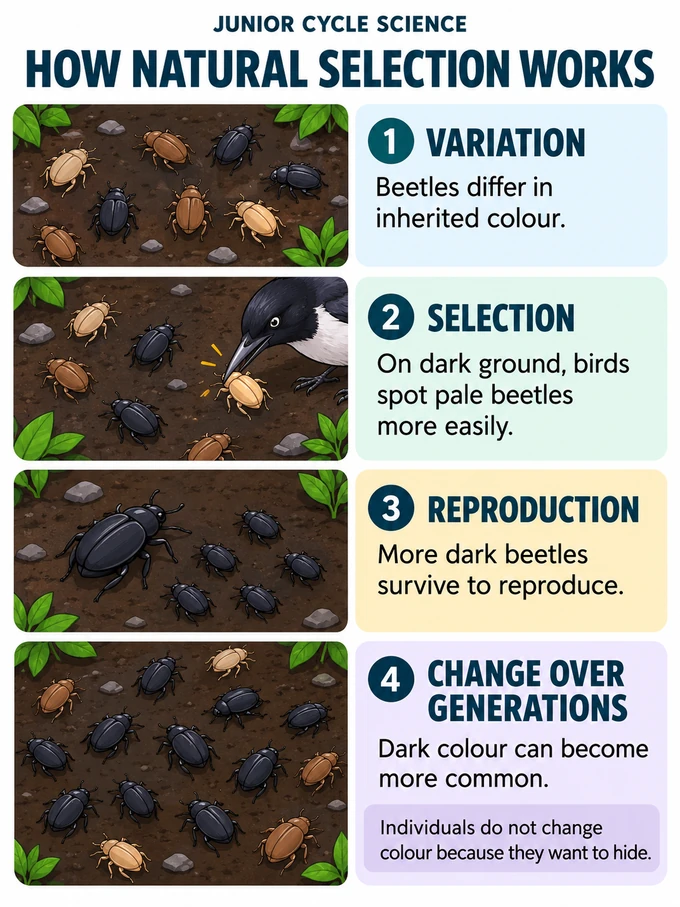
Imagine pale and dark beetles living on dark ground. Their colour is inherited.
- Birds see the pale beetles more easily, so they eat more of them.
- More dark beetles survive and reproduce.
- The survivors pass on inherited colour differences to their offspring.
- Over generations, dark beetles may become more common. They do not change colour because they want to hide.
Adaptations depend on the environment
An adaptation is an inherited feature that helps an organism survive and reproduce in its environment. Camouflage, such as a beetle’s dark colour, is one example.
The same feature may not help everywhere. Dark beetles may be easy for birds to spot on pale ground. A useful feature can become less useful when conditions change.
Evidence for evolution
Scientists use several kinds of evidence to investigate evolution.
- Fossils from different ages show how organisms have changed over time.
- Similar body structures and DNA can show relationships between species.
- Changes can be observed in living populations, such as increasing antibiotic resistance in bacteria.
Antibiotic resistance
A bacterial population may already contain a few bacteria that resist an antibiotic.
- The antibiotic kills many non-resistant bacteria or stops them reproducing.
- Resistant bacteria survive and reproduce.
- Their descendants can inherit resistance, so resistant bacteria become a larger share of the population.
- It is the bacterial population that changes. The patient’s body is not becoming used to the antibiotic.
03Worked examples
On dark ground, birds eat more pale beetles than dark beetles. If surviving dark beetles reproduce and pass on their colour, dark beetles may become more common.
Work through it
- Begin with pale and dark beetles: the population already varies.
- Dark beetles are harder to see on dark ground, so more survive.
- Survivors reproduce and pass on inherited colour differences.
- Repeat over generations: the proportion of dark beetles may increase.
04Common mistakes
Common mistake
“An organism develops a helpful feature because it needs it.”
Remember: Inherited differences already exist or arise by mutation. Natural selection changes how common they are over generations.
Common mistake
“Survival alone explains natural selection.”
Remember: Survivors must reproduce and pass on the helpful inherited feature for it to spread to later generations.
05Answering questions
- Build a natural-selection answer in order: inherited variation → survival and reproduction → inheritance → change over generations.
- Use the stated environment to explain why a feature helps. Dark colour helps camouflage on dark ground, but may not help on pale ground.
06Infographic & reference diagrams
07Try an investigation
Use pale and dark counters on different backgrounds to model camouflage. Sample the visible counters, then model a new generation from the survivors. Compare results over several rounds.
Do practical work with your teacher and follow the laboratory safety instructions.